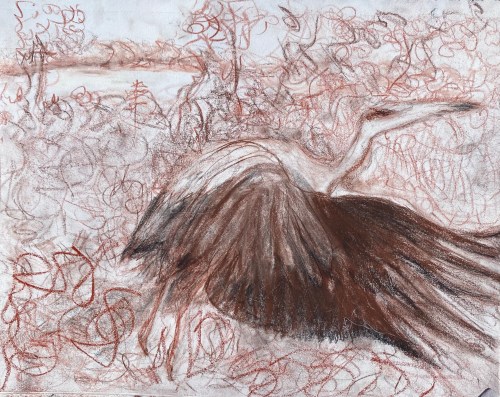
Sketching in the field with crayons, imagining how the heron feels and looks, quickly using pencils and erasers while on the fly, is fun. Below, are three renditions of the same bird that I keep in my sketchbook for planning a larger oil or acrylic painting at a later date.
The bird was flushed out of the marsh as we ever so carefully approached her. It is so exciting to see her wings flowing into flight, as she flaps her way out of the grasses and winds her way nearer to the water and farther from us.
How can I emphasize her majestic wings? How do the textures of a marshland get depicted so that she fits comfortably, seen and hidden at the same time?
There she is for that brief moment then up into the air and away. What did I see? What did she sense as she fled her surroundings for a quieter place?
Sketching tools
First lines – Structure
Such a beautiful bird. And now to reveal the idea of her in a painting. She will linger in my memory for quite some time.
This is the to be continued story of my painting exercise on an old canvas where I shift from idea to idea and technique to technique while “holding that structural thought.” Currently, I am playing with a painting of ocean and atmosphere and considering their shared emergence into the sense of horizons.
I find the choices in painting horizons to be infinite. Much like a snowflake, each depiction of a a horizon is unique, yet somehow we continue to recognize the horizon for what it is.
We may continue to sense the horizon even when we cannot really see it.
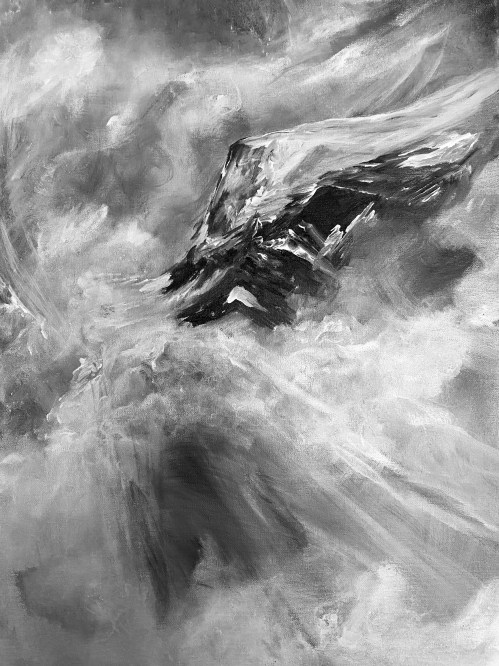
Horizons do not need to be depicted as straight lines across the canvas. Some artists have horizons that are shown via diagonal slopes. Here is an example painted by my sister, Elizabeth Rose. I like the sense of view that she is approaching the mountain from the sky rather than viewing it from the ground.
Elizabeth Rose, acrylics
My sister Elizabeth and I both paint and we enjoy sharing our paintings and styles with each other. She paints in her living room. I have an art studio in my basement. We both reach for new understandings through painting. We both have grandchildren who enjoy painting and sketching with us. It is a wonderful way of relating.
In Elizabeth’s case, she is painting a kind of revelation that reaches awesome thoughts of clouds and light trajectories across majestic mountains that seem to reach beyond our planet and out to the universe.
I show her painting in black and white to emphasize the point of motion and shifting light.
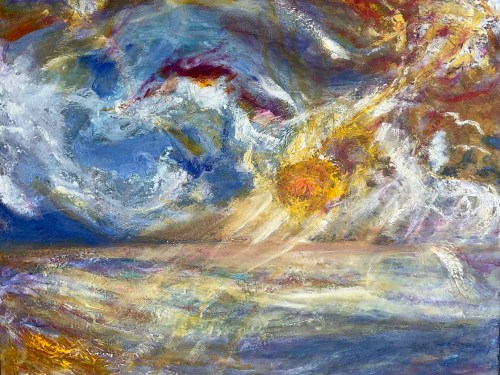
In my experimental painting, I am imagining an early morning sunrise out in the ocean on an island, where color, reflection and time are all blurred or merged into a single multi sensory, abrupt experience
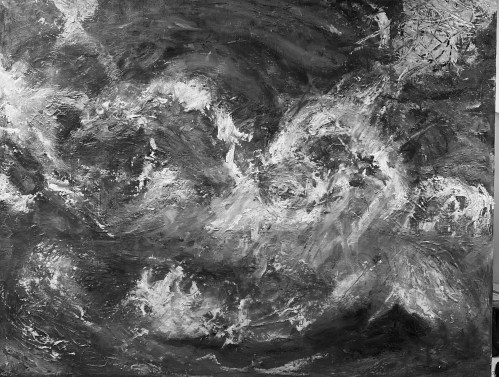
I started with this roughed up canvas using white and black for the emphasis of light and dark areas (Canvas A).
Canvas A
Then I prepared a kind of Notan design that suggests motion as well as balance of light and dark (Canvas B).
Canvas B
Then I shifted to the underlying pastels of sunrise ( Canvas C).
Canvas C
This was followed by the over-slap of bright colors put on by palette knife and softened by brushes to be reflective of the split-second deeply bright shooting sunrise itself (Canvas D)
And as it looks today, I have worked on grasping the abrupt brilliance of those few split seconds where sunlight takes over the morning skies and water reflections
Canvas D. Early Sunrise, Oils
In conclusion, much like life itself, all present paintings have pasts and futures to contemplate. Horizons are moving targets just like everything else and our sense of timing and judgement of their emphasis is an artist’s prerogative.
Art is my muse. From art, I receive an endless supply of inspiration.While I like to think that I an in charge of the creative process and am inspiring the painting, I am finding instead that the creative process of art is actually inspiring me.
Here is an example.
The idea of painting a bird series started when I was doing a small watercolor on one of those commercially produced blank watercolor cards that I planned to send to a friend (Perspective 1). Unexpectedly, this small watercolor painting on a greeting card became a source of inspiration for an exploratory series of paintings experimenting with alternative media.
At first I asked, how might this painting have looked if I had used oils instead of watercolors?
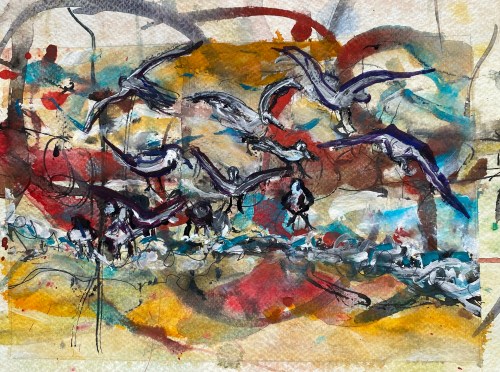
Perspective 1: Watercolor and ink, 4” x 6”
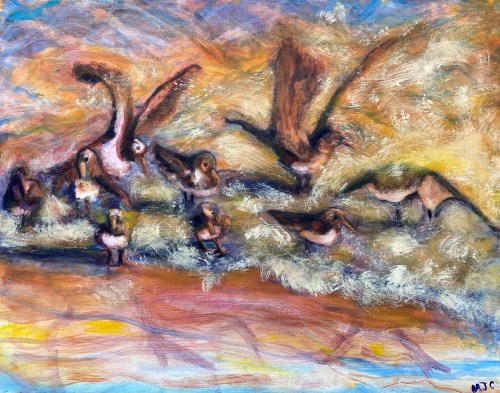
When I first noticed the birds, they were running as a glorious team in front of ocean waves softly rolling into the beach, the birds hurriedly capturing their meal of tiny fishes and bugs from the sand as the waves rushed back to the sea.
It was a few hours before winter sunset on the Abacos islands. The birds and I were standing on the beach in the sharp shadows and strongly contrasting light of early dusk. As I stepped closer to them, the birds fearlessly continued to shift back and forth with the waves, their legs moving quickly and in unison. It was fascinating to watch them perform with such measured uniformity of step. When I walked a bit too close for their comfort they started to skitter away.
And it is that particular moment, when they shifted their attention, that I wanted to paint.
Perspective 2: Oil painting, 22” x 28”
After completing the small watercolor sketch (Perspective 1), I decided to try again in oils on canvas, this time with greater attention to the late afternoon ocean colors, but still using a similar structure for the painting, resulting in Perspective 2. This oil painting reflected more stillness with most of the movement being from the waves washing against the shore while the birds stayed in position enjoying feeding time while small waves washed over them.
I decided to try the painting again and increase the commotion in the picture.
Wet- on- wet background in watercolor
To do this, I started by preparing a background of wet-on-wet watercolors on paper. Once this dried, I then watercolored over it and also used ink to complete the painting. The resultant painting called Perspective 3 is below. It did have the desired feel of commotion while also adding new lines and shades of interpretation.
.
Perspective 3: Watercolor on paper, 8” x 11”
Moving on, I tried again, this time asking, can I replicate this painting using a digital arts package such as Procreate?
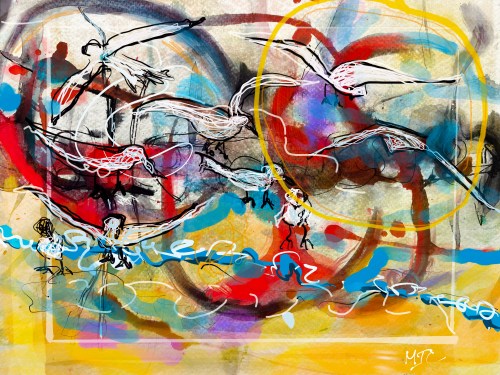
I started by using a photo of the same wet-on-wet watercolor background that was used for painting Perspective 3 and super-imposed graphics over it. The birds were superimposed over the photo as were shades of color and selected lines. This was experimental on my part and was a first attempt at actually using digital arts for a painting . Here is what happened (Perspective 4).
Perspective 4: Digital Art using Procreate on an I-Pad
It struck me as odd that the only way I could produce Perspective 4 was to print it out, or I would have no physical evidence of my art piece. But that is the nature of digital design.
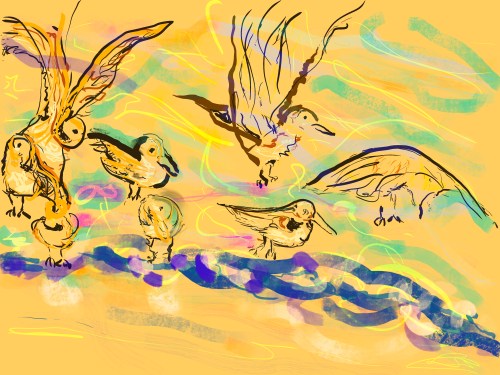
I also did one piece that was digital only, just for fun and it is Perspective 5. This time I focused attention to the birds’ positioning, letting the motion be implied by the waves .
Perspective 5: Digital Art
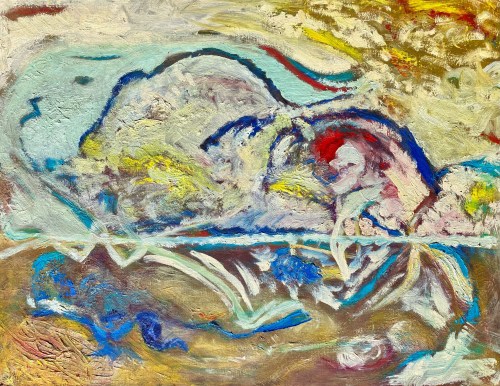
Finally, I returned to the physicality of oil paints and canvas and tried the same idea as an abstraction and this is what happened.
I continued to keep a similar structure in my mind while attempting to tell the story of the birds through color variations, brush movements and paint textures. My goal was to leave the feeling of moving water and birds without actually painting them as objects, resulting in Perspective 6.
This was also a challenge for me as I have struggled to reach all the way to abstraction and beyond impressionism. This time I think I made it.
Perspective 6: Oil painting on canvas,” 22’ x 28”
What did I learn from all these variations on the same painting?
What I learned is that the perspective that I take affects the outcome more that I ever might expect, even when the goal or intention of the painting is roughly the same.
As an analogy, if I were writing a story and I choose to write it in the first person, or the third person, it changes the orientation of the story. If I choose this actor or that actor to play the part in a play, or make a remark, the perspective of the story subtly shifts. If I choose these words over others, the entire mood of the short story may change.
The resultant stories that we tell or write have their own lives, independent of the writer’s or the story teller’s original intention. This is true, as well for art.
I believe that this is why it feels so daring to paint and why sometimes people may initially shy away from trying it. It is because each piece of art has a life of its own. It is because of what we may reveal in the process and may not necessarily expect. Perhaps we don’t even initially know this is going to be the painting we have in mind. But now that it is completed we see it as a real and independent construct that may, perhaps, be scrutinized by others, reinterpreted and possibly shared in new ways.
It is very daring to go through this creative endeavor, almost always resulting in further development and inspiration.
It went through several iterations and is part of a project that I am working on.
Beginnings, in oils on canvas, 22” x 28”
There is a feeling of satisfaction and a type of introspection going on in my head when doing a creative study such as this as I freely put up the colors and textures where I want them, adding them with a joyous sort of freedom.
This is the first abstract I have tried that I sense is complete. It is a complete thought, an idea that I envisioned using a brush and some paints.
I don’t want to touch it.
No mini maneuvering would improve it for me. It is a new beginning, unexplained and free.
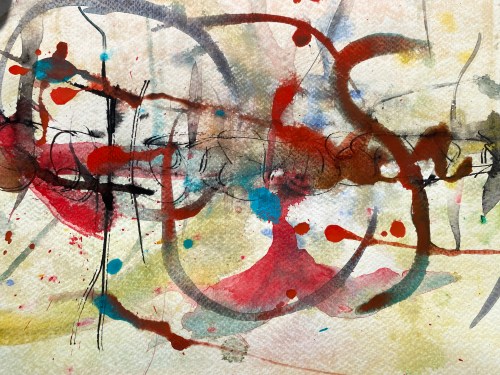
Calligraphic messages seem to be everywhere in nature. They emerge from our natural surroundings and are etched into our consciousness.
By referring to “nature’s calligraphy”, I refer to a form of art that is inspired by nature, yet looks like handwriting or calligraphy, and has artistic implications that go beyond the written word.
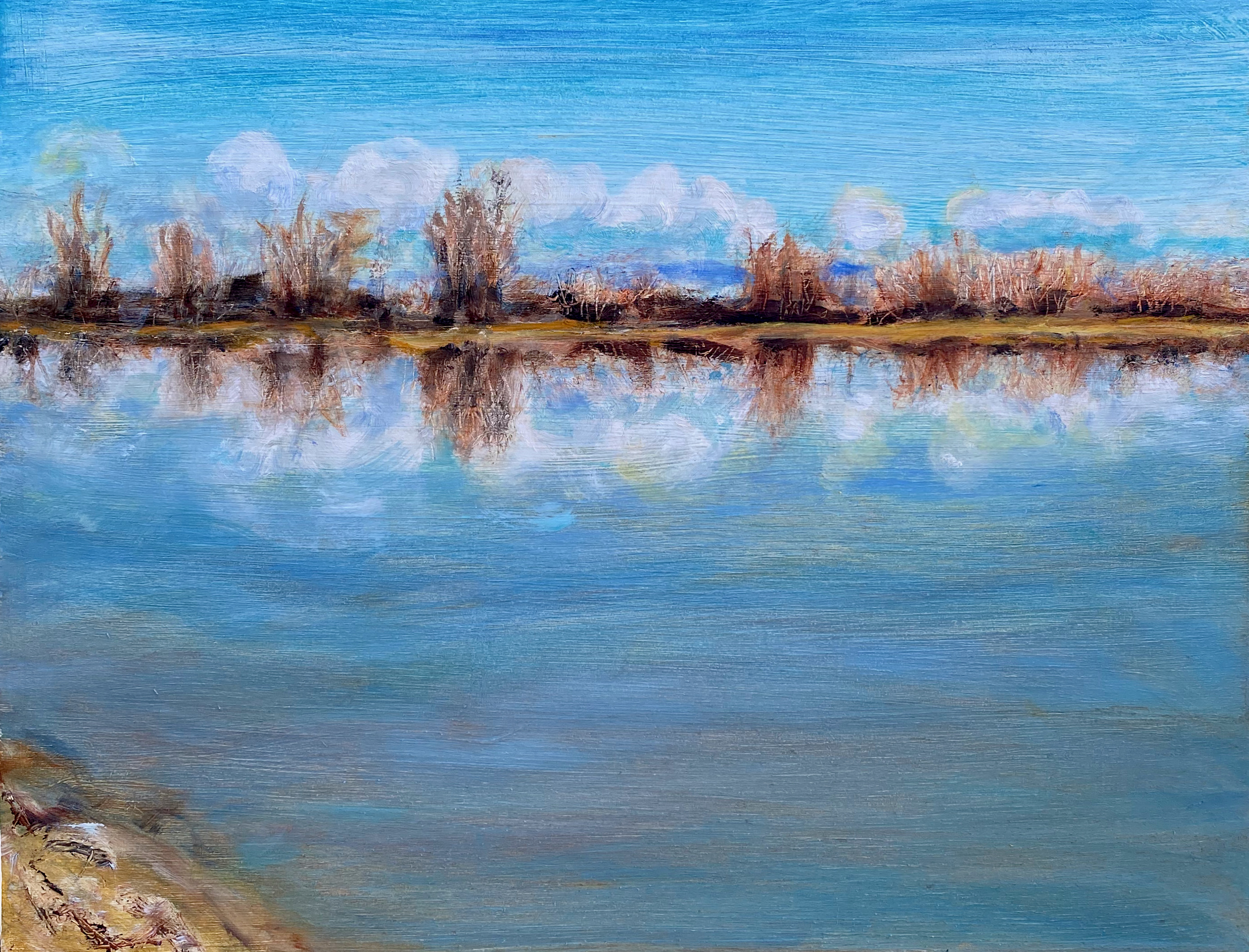
Sauvie Island Calligraphy, oil painting on birch wood
How do I ever know what to paint when standing in such beautiful natural scenery? Where does land end and water begin? What color is the in-between?
I know by my feelings when to start painting. I will sense when that moment is here.
It is when my eyes stop at a point, where I ponder what I see, where I wonder how this place even exists it is so ephemeral. Then it is time to paint.
This quiet moment is in March and occurs while walking off-road at Sauvie Island, near Portland, Oregon We are standing in a field, looking at almost still waters. The scrub bushes and small trees on the other side of the pond are sending what looks like a calligraphic message, punctuated by clouds.
It is our first time out in a long time, owing to COVID constraints. This is also a global pandemic moment for us, an outing free of other people, social-distancing not required.
There is no noise, but for soft sounds of birds. It is a perfect moment.
It is now a painted moment.
In my mind’s eye, I see this same scene in another way, as calligraphy.
I plan to paint this again, but in a much wilder, simpler way, via the style of a notan.
The above painting was completed during the period of time that I have been taking the art classes of Michael Orwick, offered by the Oregon Society of Artists.
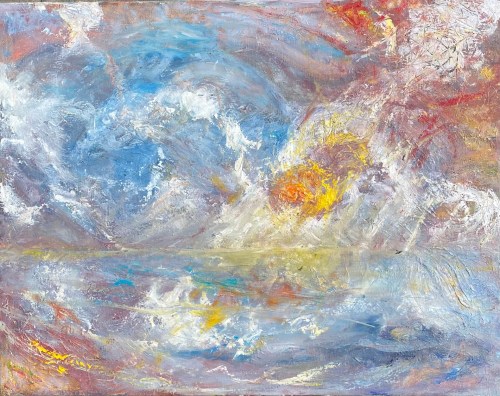
When I was a child, some of the first things I thought to draw were pictures of the sky. It would seem that clouds were the easiest thing to draw in the world. I took my crayon, put up a white oblong shape, perhaps with the yellow sun peeking out, and was done. Voila! I had painted a cloud.
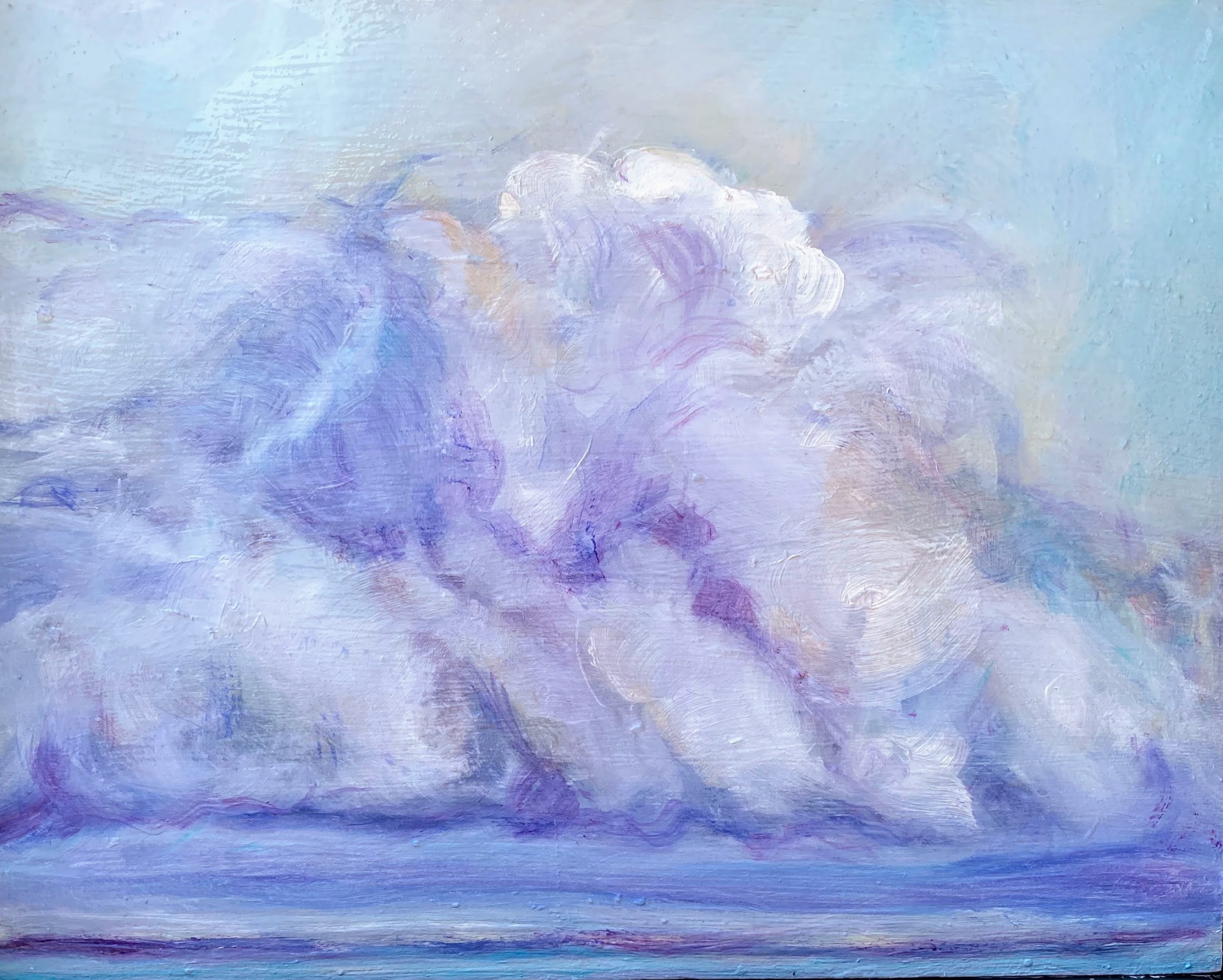
Clouds over Water, oil painting
Now that I am an adult, painting clouds as part of a painting exercise for an art course, I am amazed how elusive, expressive and complicated they are. Where does a cloud begin, and when does it end? How does the sky manage to peek through the clouds in such soft and unimaginably subtle ways? Do I ever really paint a cloud, or rather an allusion to one?
The more I paint them, the more amazed I am with the ephemeral nature of clouds.
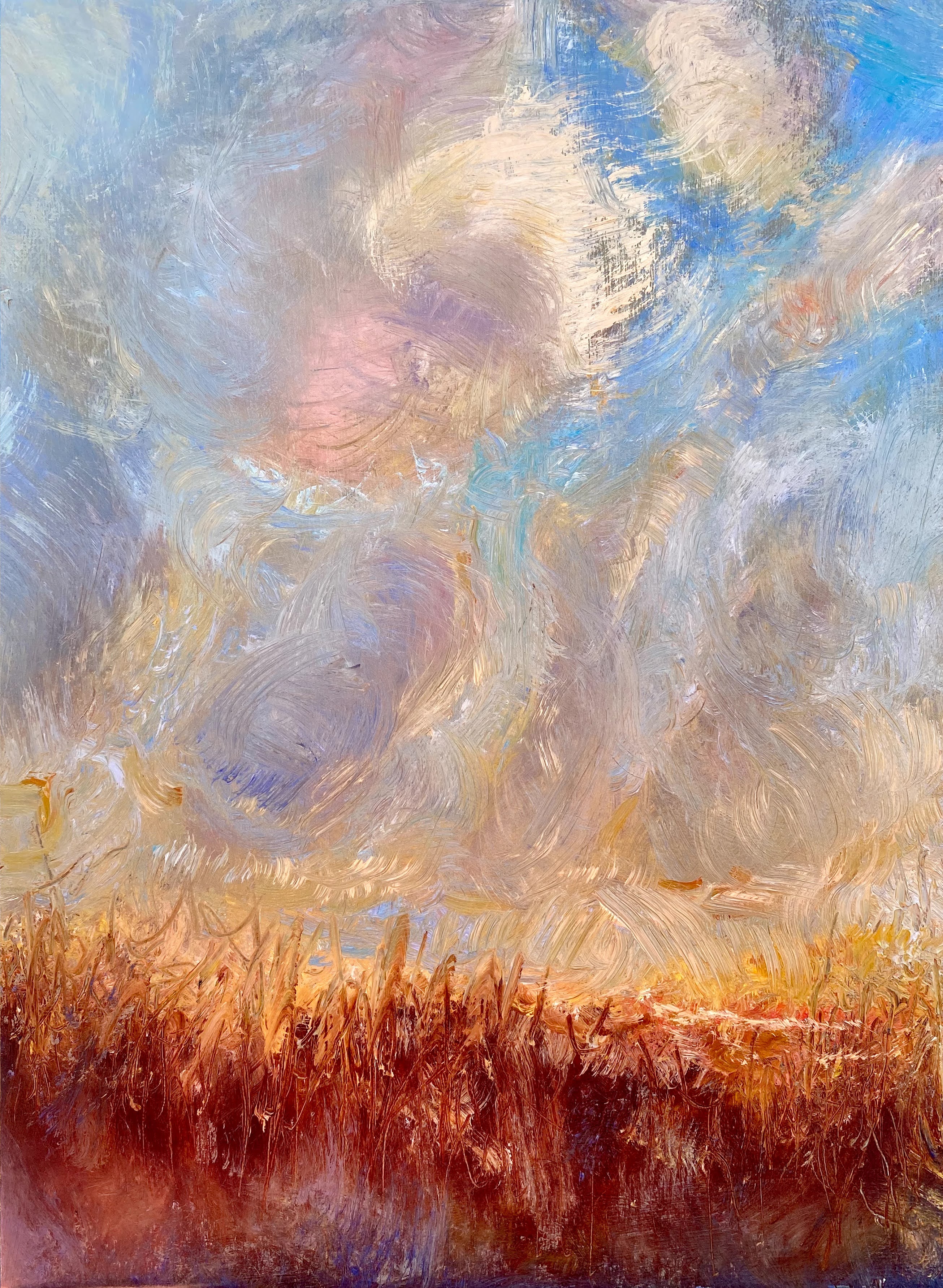
Clouds over Island Sunrise, Oil painting
It is a challenge to use less and less color in a painting, yet still have the colors of the atmosphere roaring through, bouncing everywhere, not respecting boundaries. I think this happens often because of our focus on light streams and reflection, in addition to shape.
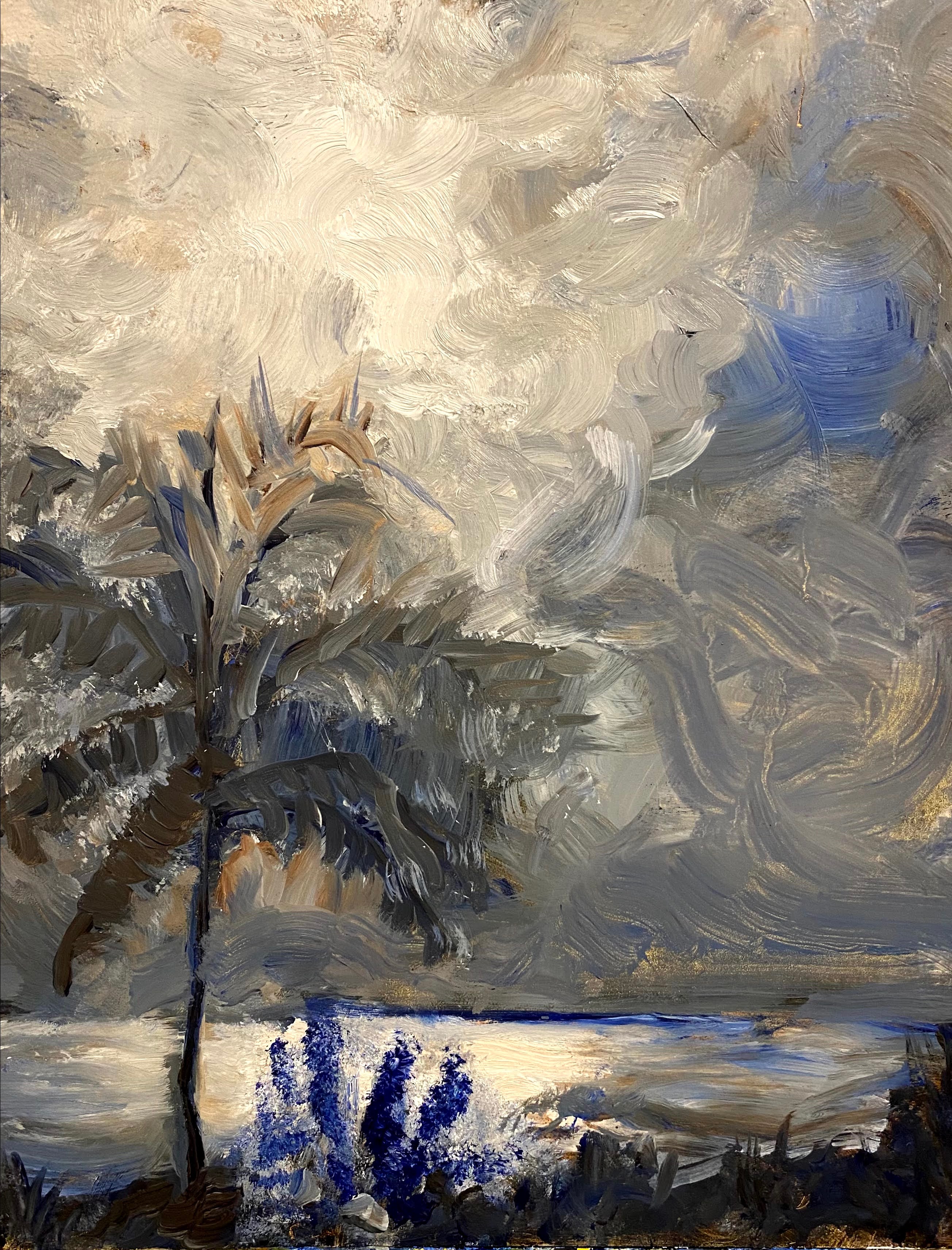
This seems to be true, even when painting clouds from the light of the moon.
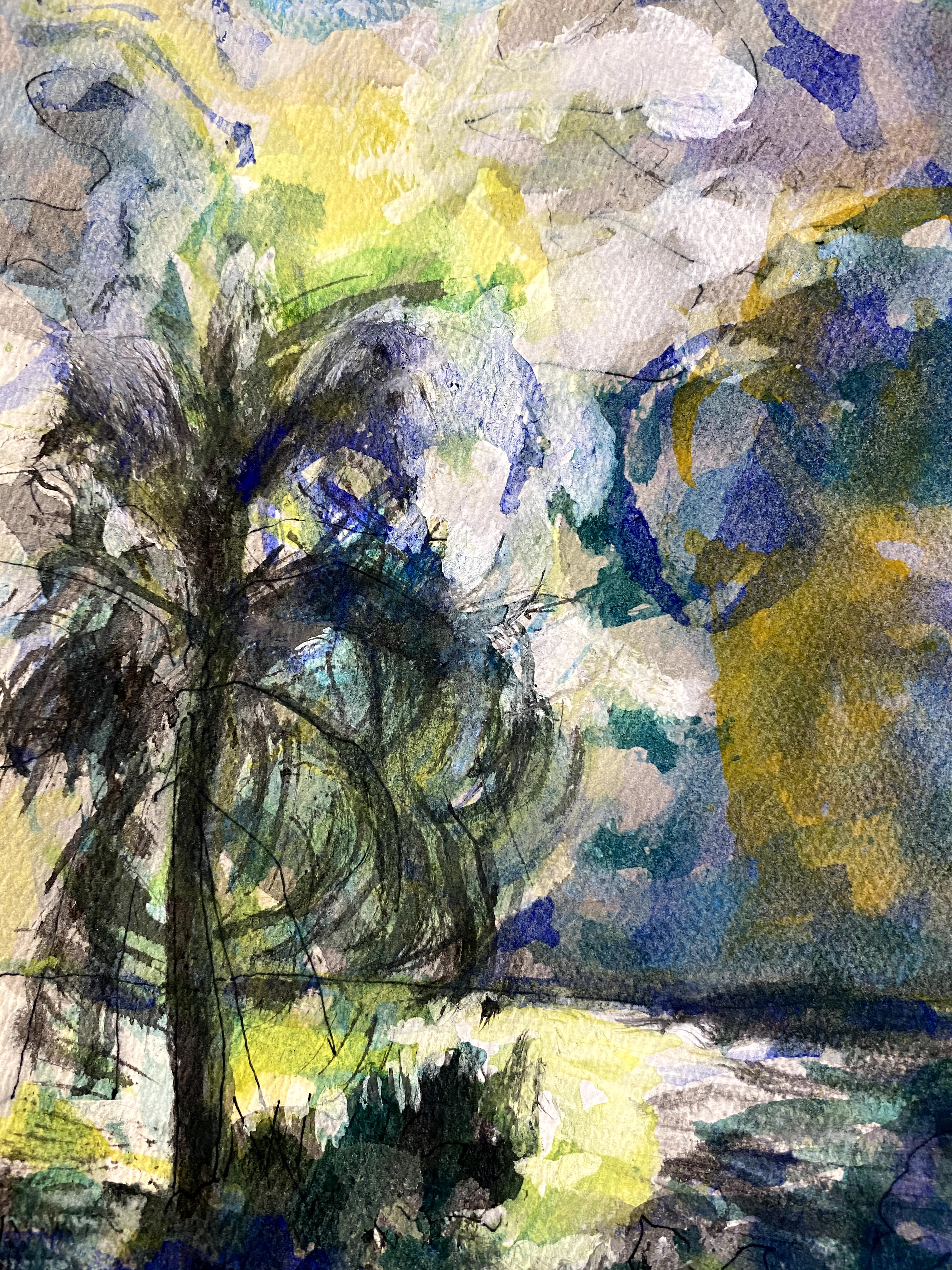
Clouds in Moon Light, Oil PaintingClouds in Moon Light, Water Color, Ink and Gesso
Now that this idea of painting clouds has become part of my daily art routine, I expect to see many new ways to relate to them with canvas, brushes and paint. Once discovered, never forgotten.
The above paintings were completed this year, during the period of time that I have been taking the art classes of Michael Orwick, offered through the Oregon Society of Artists.







 marysgardens