There are two important switches we have in life. On and off. Birth and Death, for example. Or, act and don’t act. Then, there is go or stay. Try or quit. And the list goes on. Any computer specialist, however, will tell us that even binary decision-making can get pretty complex in a hurry. When one adds up all the many possible “do’s” and “don’ts” they might even be contradictory or lead to circuitous results.
In situations where life has gotten very complicated, it is useful to go back to thinking about simple switches. And along with that, we must learn to turn off complicated and ridiculous choices that do not have to take place.
There are times when it may be best to be in the middle ground, somewhere between on and off, or yes and no. Shades of gray. This means yes, under the following conditions; or no, if this happens.
How do we know which button to push?
Most of us come up with a set of policies or understandings to decide what to do now, some based on previous experiences, some part based on what we are doing right now, and some part of it based on what we expect to do in the future.
Then there is this.
We are not alone pushing buttons. Others around us are pushing their buttons too. This makes decision making even more complex.
When I reach this point, I often take out a pen and a paper and start writing my choices, listing what I think is important. If I am not ready to do that yet, then I draw, or take a walk or go outside and do some gardening.
Artistic expression and exercise, in my opinion, is an important aspect of decision-making, giving the mind pause and space to think through.
I use this internet site, much as I would a paper and pen, to compose my thoughts, and to exchange ideas with a small community of friends and family.
Yet, just as some hikers stop to freely appreciate the view, some swimmers sense the clean waters in which they swim, some walkers regale the trees along the paths they take, some stargazers sit under the dark night sky and imagine the size of the universe, some stop in to appreciate a painting, to read a poem or to ponder a story.
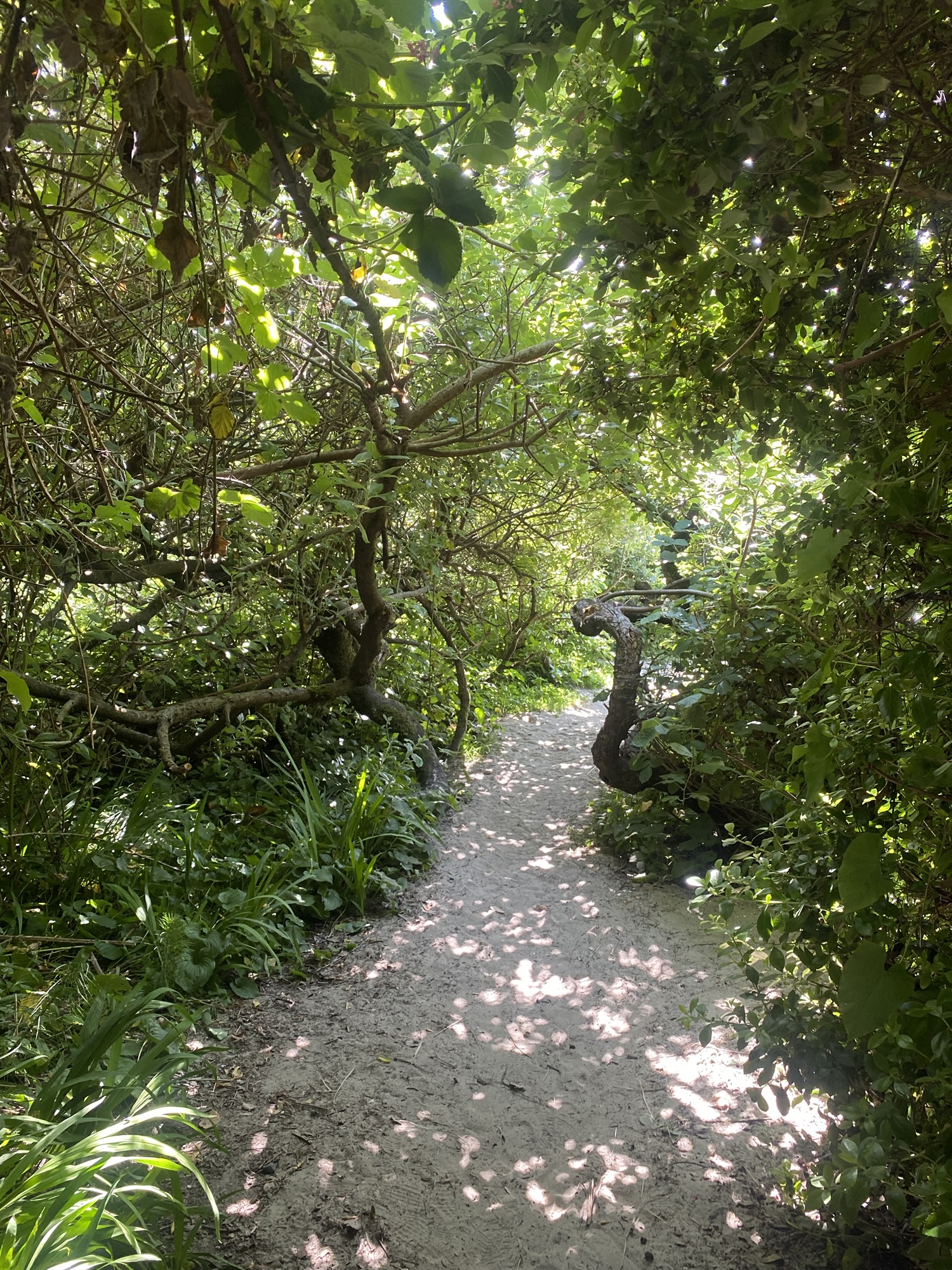
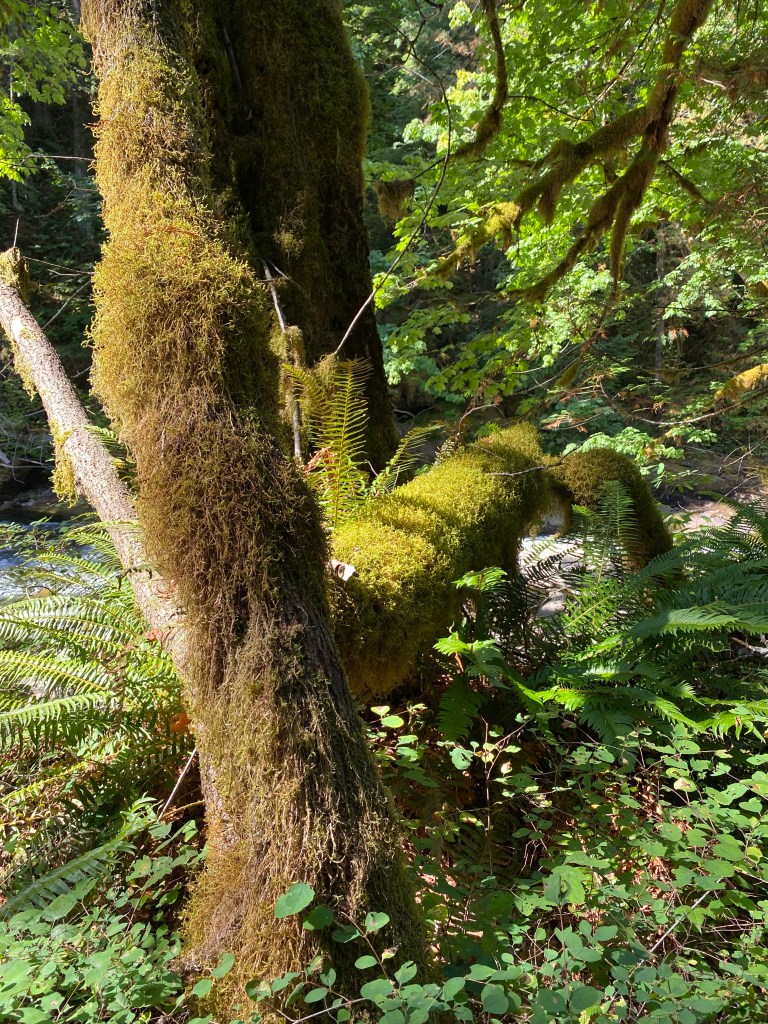
Personal photo taken on the Old Salmon River Trail
Art is my muse. From art, I receive an endless supply of inspiration.While I like to think that I an in charge of the creative process and am inspiring the painting, I am finding instead that the creative process of art is actually inspiring me.
Here is an example.
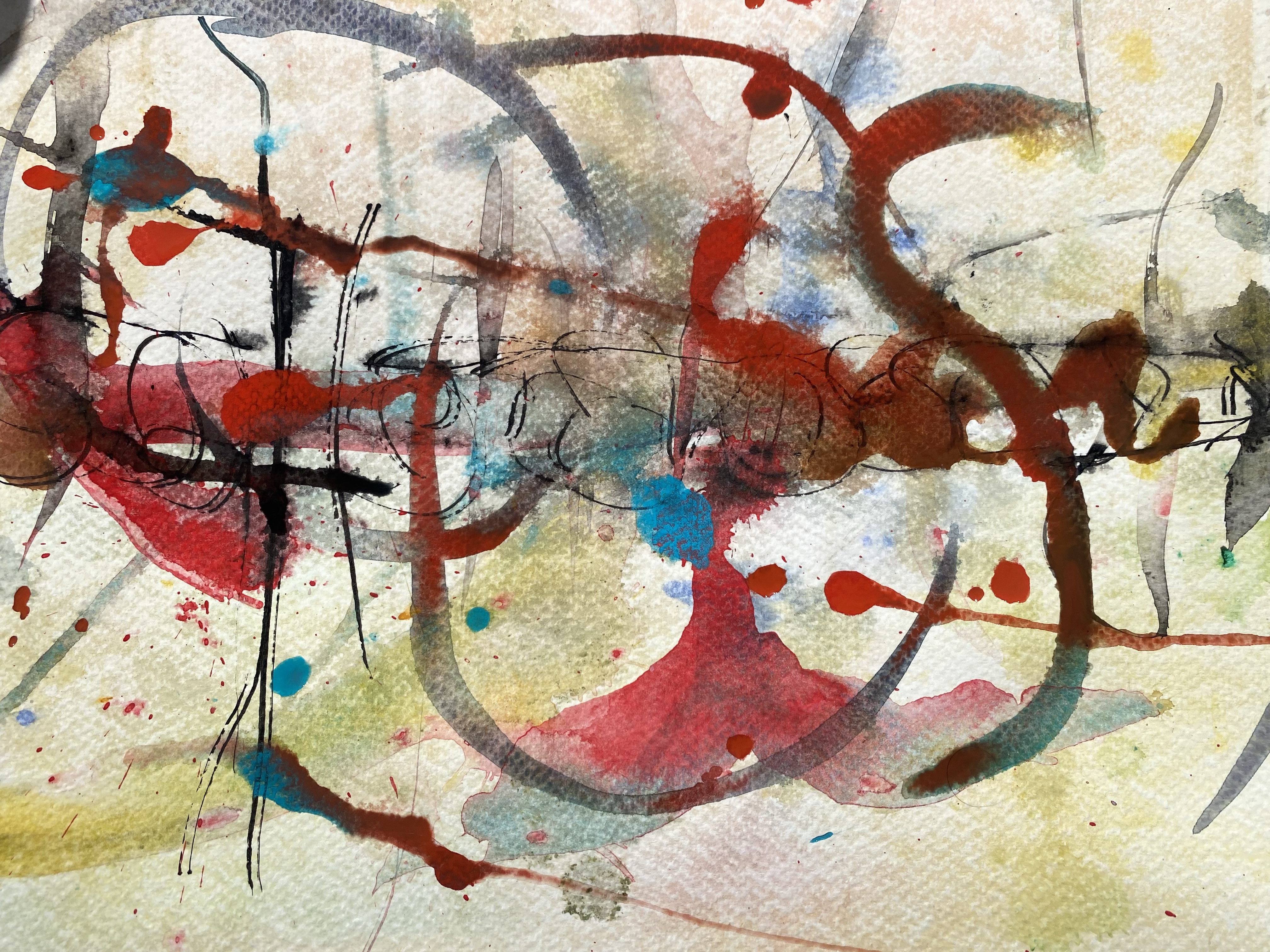
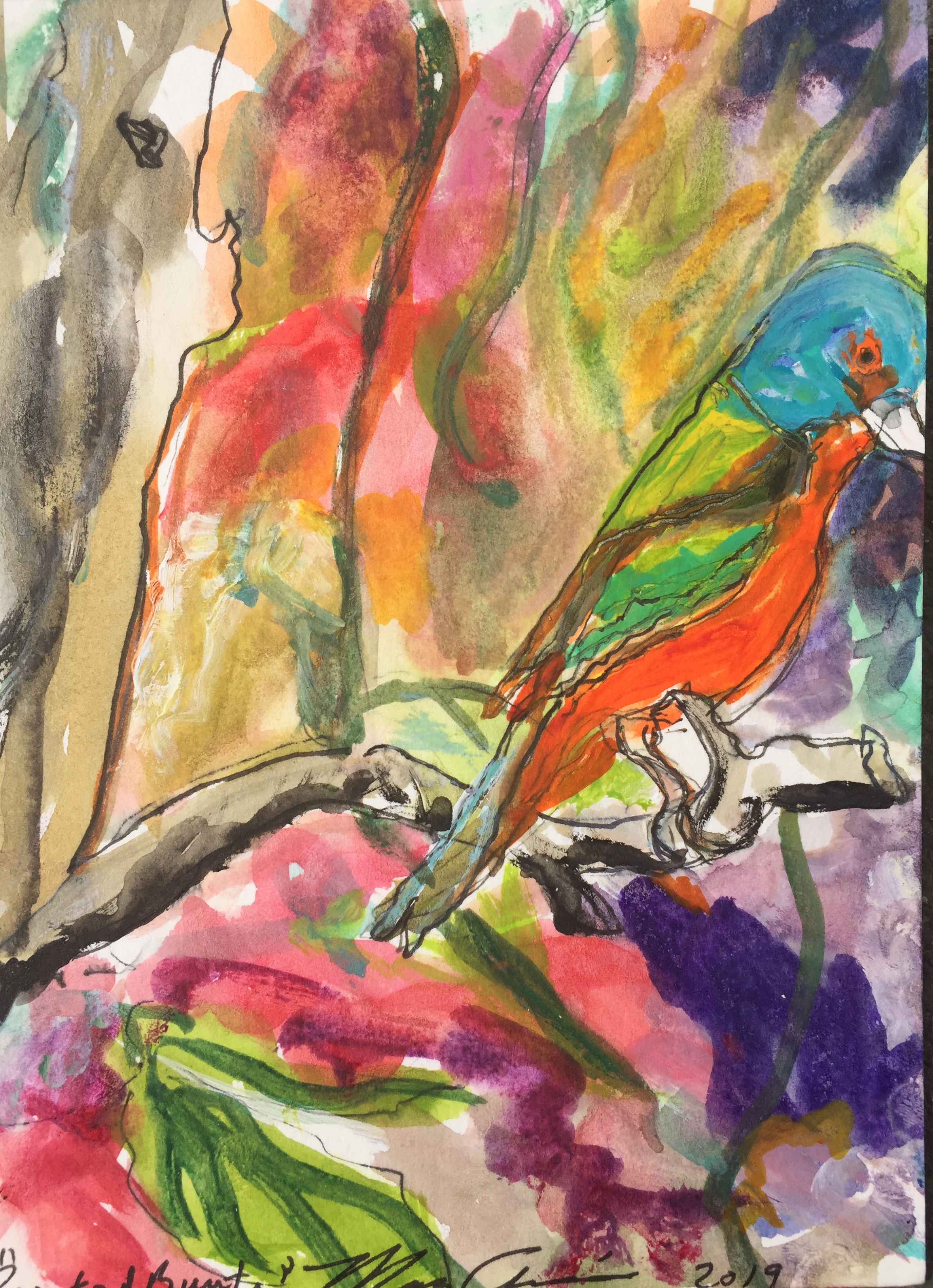
The idea of painting a bird series started when I was doing a small watercolor on one of those commercially produced blank watercolor cards that I planned to send to a friend (Perspective 1). Unexpectedly, this small watercolor painting on a greeting card became a source of inspiration for an exploratory series of paintings experimenting with alternative media.
At first I asked, how might this painting have looked if I had used oils instead of watercolors?
Perspective 1: Watercolor and ink, 4” x 6”
When I first noticed the birds, they were running as a glorious team in front of ocean waves softly rolling into the beach, the birds hurriedly capturing their meal of tiny fishes and bugs from the sand as the waves rushed back to the sea.
It was a few hours before winter sunset on the Abacos islands. The birds and I were standing on the beach in the sharp shadows and strongly contrasting light of early dusk. As I stepped closer to them, the birds fearlessly continued to shift back and forth with the waves, their legs moving quickly and in unison. It was fascinating to watch them perform with such measured uniformity of step. When I walked a bit too close for their comfort they started to skitter away.
And it is that particular moment, when they shifted their attention, that I wanted to paint.
Perspective 2: Oil painting, 22” x 28”
After completing the small watercolor sketch (Perspective 1), I decided to try again in oils on canvas, this time with greater attention to the late afternoon ocean colors, but still using a similar structure for the painting, resulting in Perspective 2. This oil painting reflected more stillness with most of the movement being from the waves washing against the shore while the birds stayed in position enjoying feeding time while small waves washed over them.
I decided to try the painting again and increase the commotion in the picture.
Wet- on- wet background in watercolor
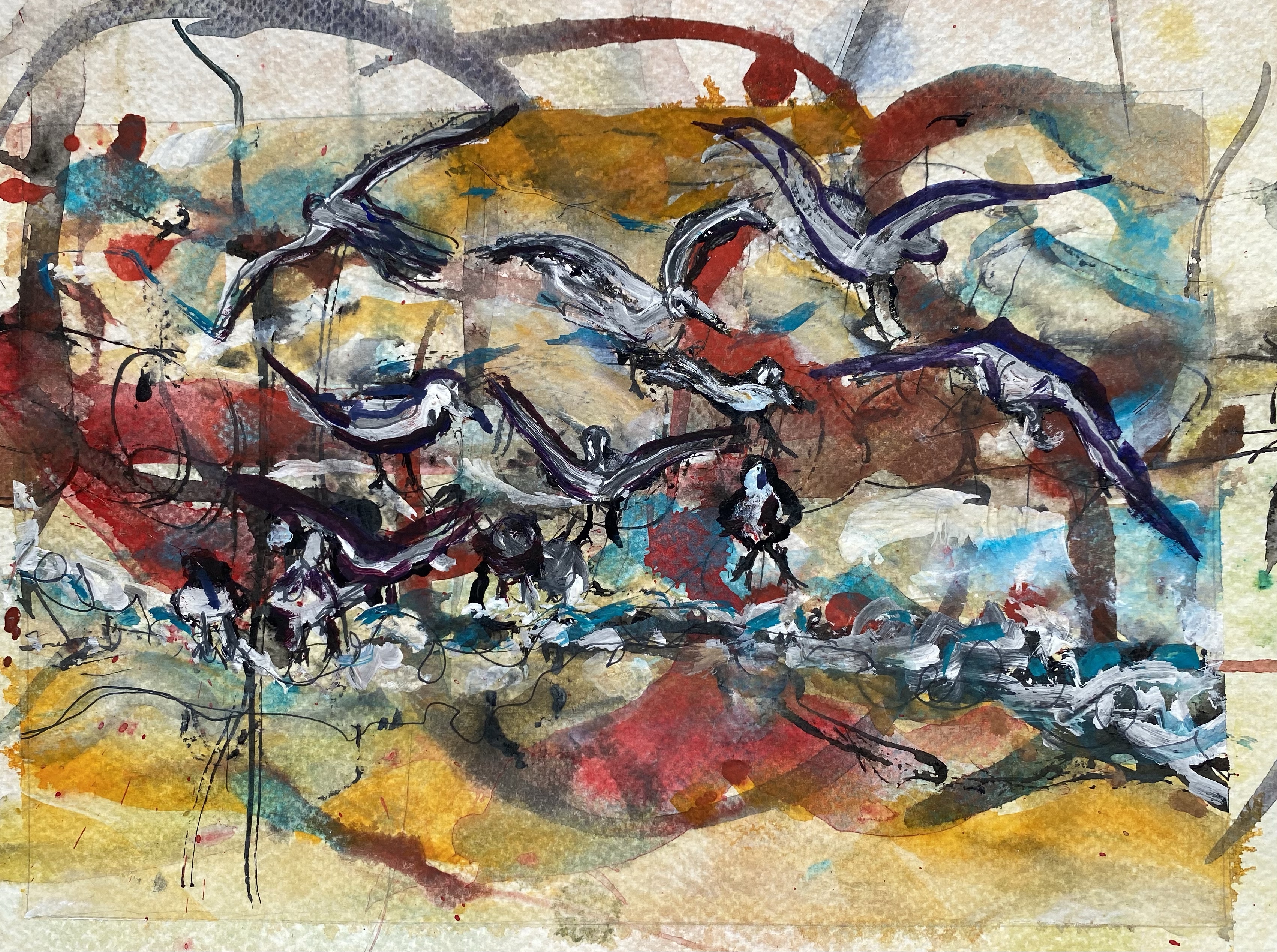
To do this, I started by preparing a background of wet-on-wet watercolors on paper. Once this dried, I then watercolored over it and also used ink to complete the painting. The resultant painting called Perspective 3 is below. It did have the desired feel of commotion while also adding new lines and shades of interpretation.
.
Perspective 3: Watercolor on paper, 8” x 11”
Moving on, I tried again, this time asking, can I replicate this painting using a digital arts package such as Procreate?
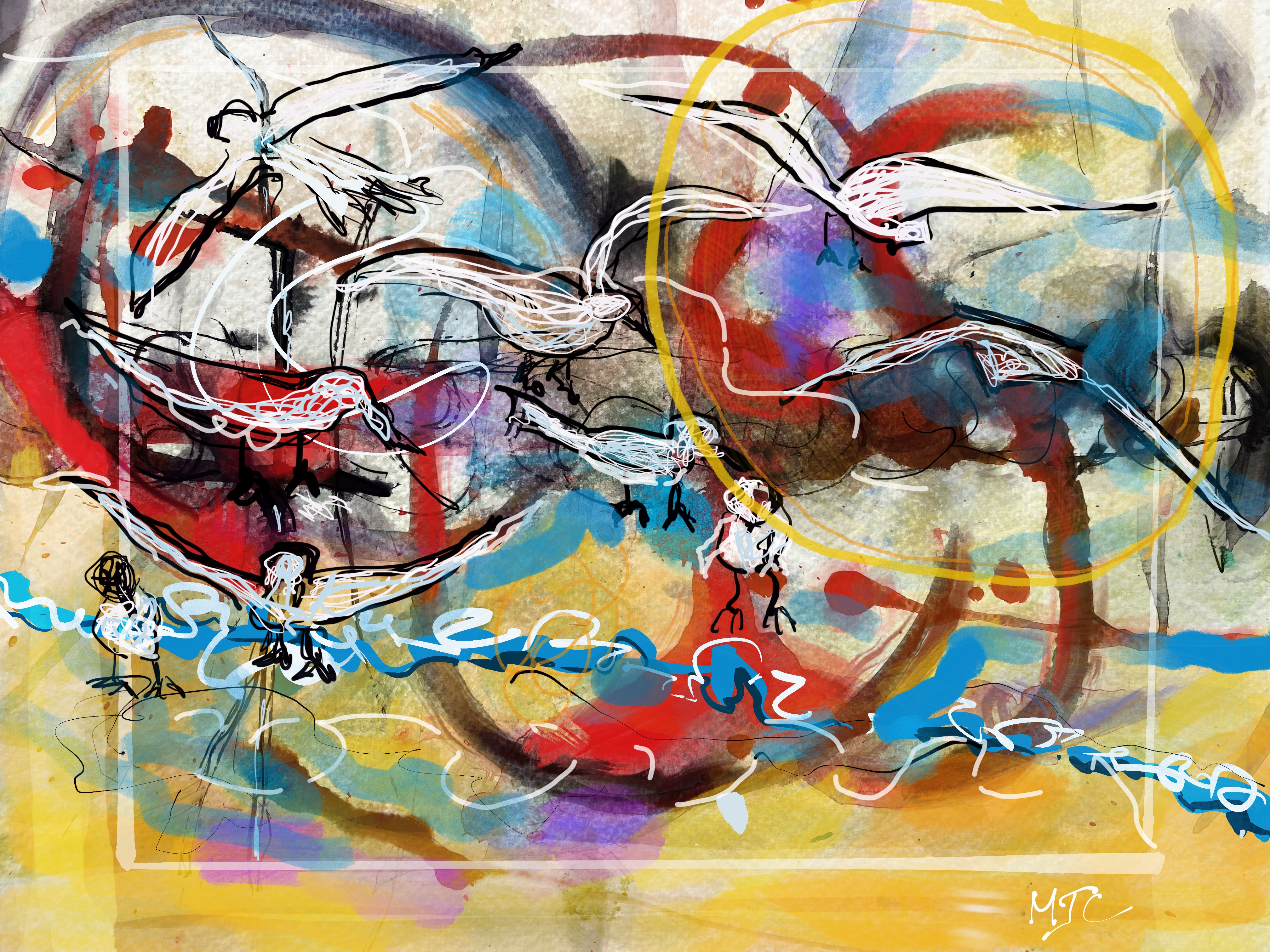
I started by using a photo of the same wet-on-wet watercolor background that was used for painting Perspective 3 and super-imposed graphics over it. The birds were superimposed over the photo as were shades of color and selected lines. This was experimental on my part and was a first attempt at actually using digital arts for a painting . Here is what happened (Perspective 4).
Perspective 4: Digital Art using Procreate on an I-Pad
It struck me as odd that the only way I could produce Perspective 4 was to print it out, or I would have no physical evidence of my art piece. But that is the nature of digital design.
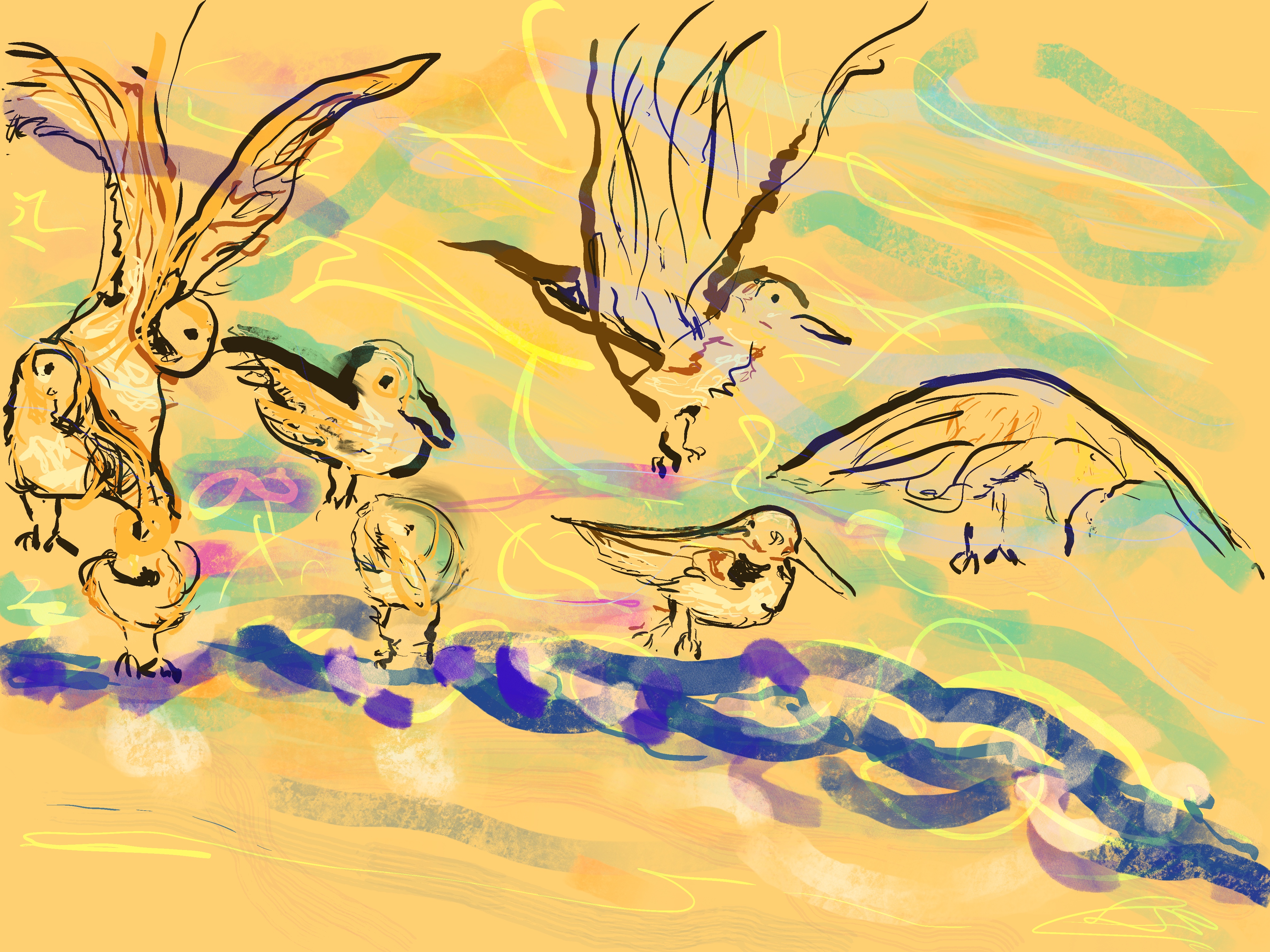
I also did one piece that was digital only, just for fun and it is Perspective 5. This time I focused attention to the birds’ positioning, letting the motion be implied by the waves .
Perspective 5: Digital Art
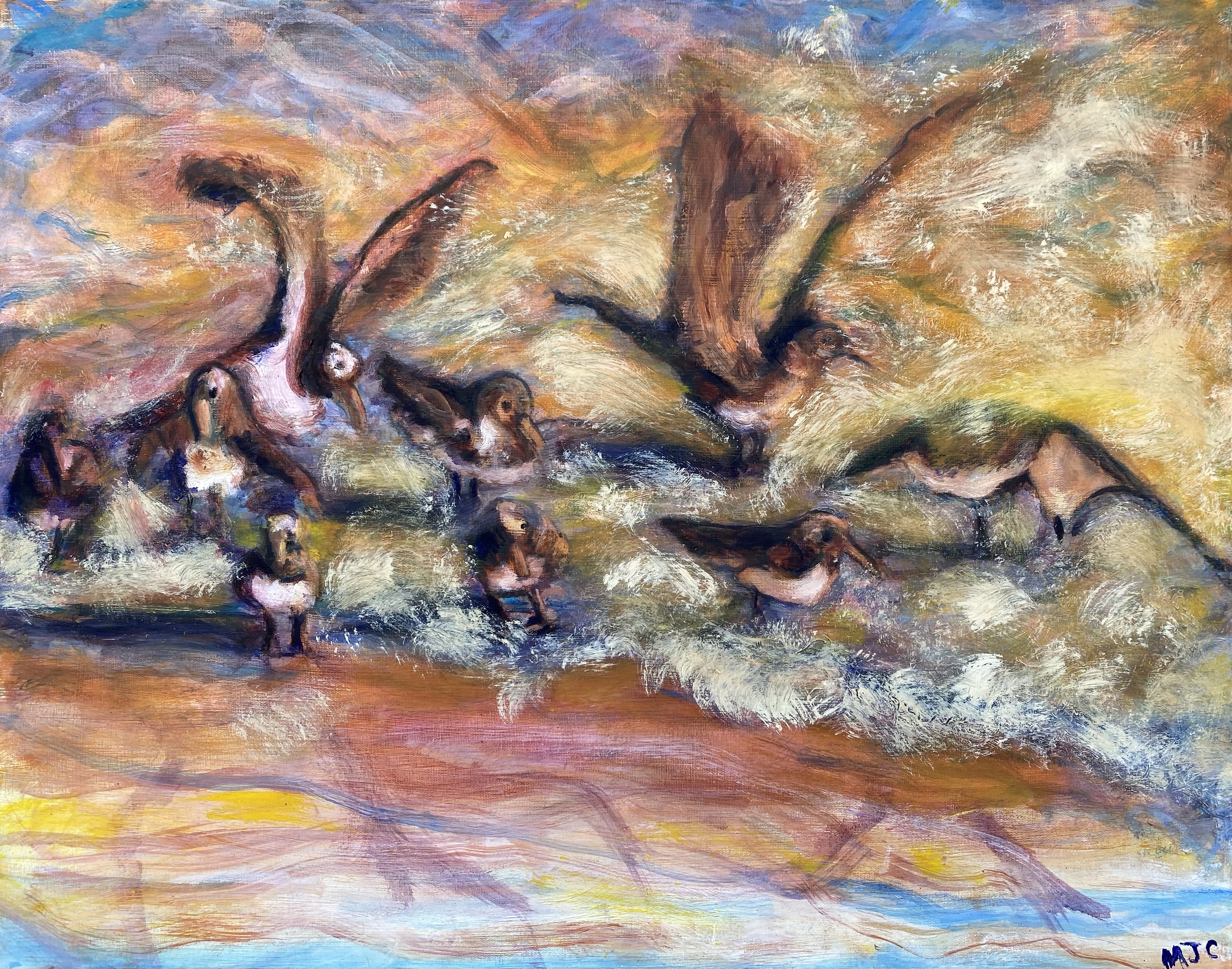
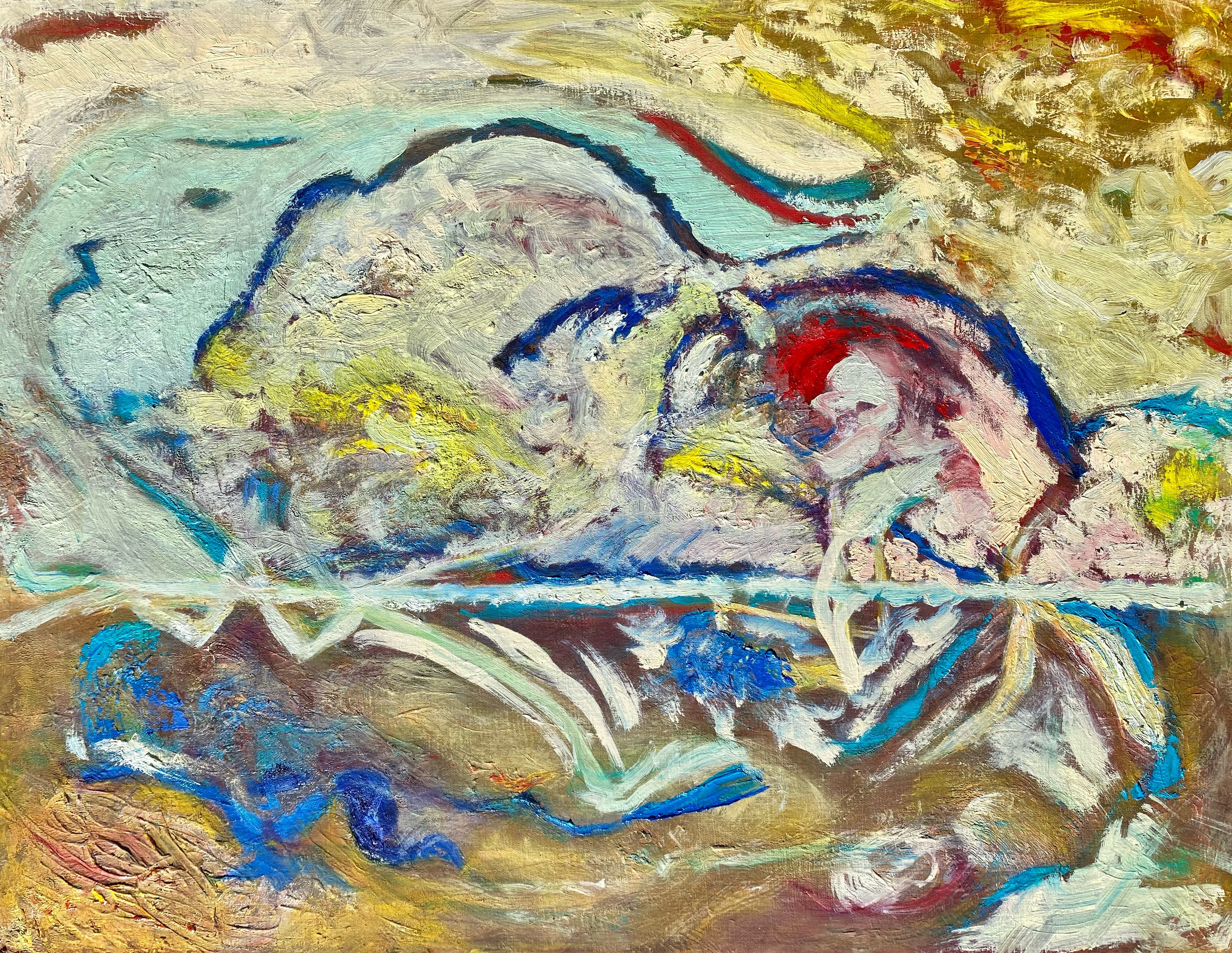
Finally, I returned to the physicality of oil paints and canvas and tried the same idea as an abstraction and this is what happened.
I continued to keep a similar structure in my mind while attempting to tell the story of the birds through color variations, brush movements and paint textures. My goal was to leave the feeling of moving water and birds without actually painting them as objects, resulting in Perspective 6.
This was also a challenge for me as I have struggled to reach all the way to abstraction and beyond impressionism. This time I think I made it.
Perspective 6: Oil painting on canvas,” 22’ x 28”
What did I learn from all these variations on the same painting?
What I learned is that the perspective that I take affects the outcome more that I ever might expect, even when the goal or intention of the painting is roughly the same.
As an analogy, if I were writing a story and I choose to write it in the first person, or the third person, it changes the orientation of the story. If I choose this actor or that actor to play the part in a play, or make a remark, the perspective of the story subtly shifts. If I choose these words over others, the entire mood of the short story may change.
The resultant stories that we tell or write have their own lives, independent of the writer’s or the story teller’s original intention. This is true, as well for art.
I believe that this is why it feels so daring to paint and why sometimes people may initially shy away from trying it. It is because each piece of art has a life of its own. It is because of what we may reveal in the process and may not necessarily expect. Perhaps we don’t even initially know this is going to be the painting we have in mind. But now that it is completed we see it as a real and independent construct that may, perhaps, be scrutinized by others, reinterpreted and possibly shared in new ways.
It is very daring to go through this creative endeavor, almost always resulting in further development and inspiration.
I wish to comment on a really wonderful article written by David Brooks that reviewed how American Christians, especially evangelicals, have responded to “three big issues that have profoundly divided them: the white evangelical embrace of Donald Trump, sex abuse scandals in evangelical churches and parachurch organizations, and attitudes about race relations, especially after the killing of George Floyd.” David Brooks, NYT
Having read his thoughtful article, asked myself this question. Is it legitimate, as Brooks was suggesting , to blame much of the current stress in our society to the failures of modernity?
Below is David Brook’s quote that provoked me to thinking about this.
Finally, Karen Swallow Prior said something that rings in my ears: “Modernity has peaked.” The age of the autonomous individual, the age of the narcissistic self, the age of consumerism and moral drift has left us with bitterness and division, a surging mental health crisis and people just being nasty to one another. Millions are looking for something else, some system of belief that is communal, that gives life transcendent meaning.
To contrast the quote from Brooks, I offer a second provocative quote from years ago, and one that changed my life along with many others.
“Today we are engaged in a final, all-out battle between communistic atheism and Christianity. The modern champions of communism have selected this as the time. And, ladies and gentlemen, the chips are down – they are truly down.”
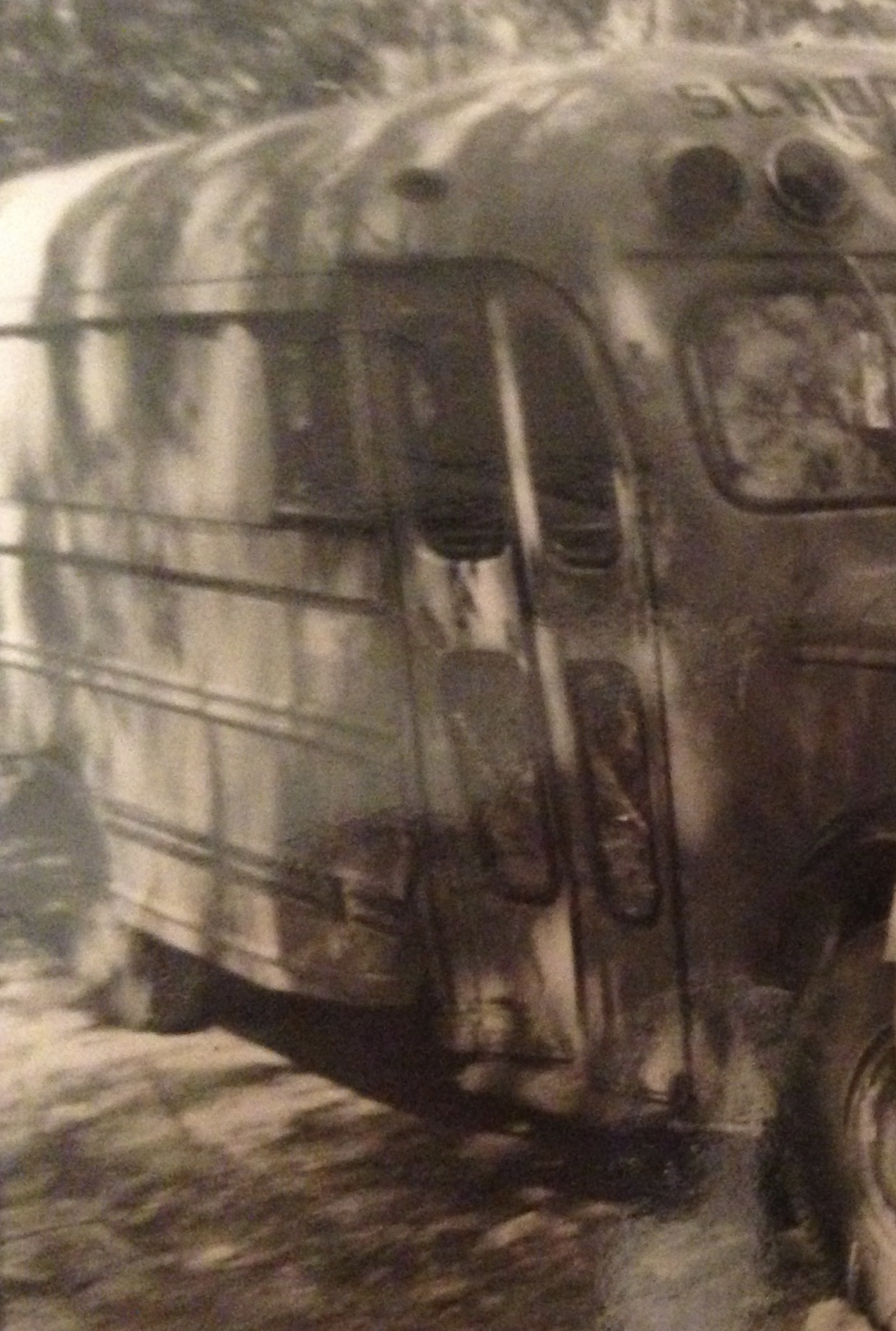
When I was ten years old, my family fled a small village in rural Ohio after my father was threatened with a lynching. I remember the men coming to our door at night, threatening him. It was described many years later in a tiny little church bulletin that I found on line while digging up my past and trying to understand what really happened. For several years, my father had been the pastor of this little church. We fled the small village, leaving all behind but for a few things that we could take with us in our brown paper grocery bags that we hurriedly packed.
It was 1956 and feelings were still politically hot in our country. Although the power of Joseph McCarthy’s false accusations in the Senate had begun to fade, there still was a strongly held belief among many Americans based on McCarthy’s political charges, that there was an infiltration of communists, socialists, atheists and civil rights activists ruining our God-loving American church way of life.
I am not really certain which of these activities our little community thought my father was involved in. Perhaps all four? But in any case, it resulted in my mother, father, brother, two sisters and the family dog having to escape this small village and live in a used school bus in which we rambled the roads from central Ohio to northern Michigan for a number of months until my father found another job and our family could get our feet back on the ground again. From our point of view, my father’s transgression was that as a soldier returning home from WWII, having been in the Asia-Pacific region for almost 10 years, he was out of tune with local attitudes and practices and thought that his small community of constituents would be open to thinking about the importance of “turning the other cheek”, pacifism, racial equality, equal opportunity and civil rights as part of Jesus’ teaching. My father clearly erred.
As a result of our exclusion, this old school bus became our sole home and form of transportation, it was everything to us. Unfortunately, it had no running water, toilet facilities, closet space or communications technology such as radio, television or phone. Most of the school bus seats, but for the first two rows, were removed leaving sufficient footage for us to put down our sleeping bags. Since we had no car, we children had a choice between standing on the road and playing under trees while waiting for our parents to drive the bus to the grocery store and come back to pick us up, or we rode the bus to the grocery store with them, while hauling everything that we owned with us, on the bus.
We felt that we were an item. Our father talked us into believing that we were on an adventure, looking for an exciting new place to live while roughing it in parts of Ohio and Michigan county and state parks. Often we stopped at the side of the road and spent the night at roadside picnic stops. This went on for a number of months.
Neither of my parents had a job. So, in today’s terminology I guess we would be described as “homeless” or at least “houseless” and our parents were certainly unemployed. That year I learned to pick cherries, filling big wooden crates called lugs, along with the rest of my family in partnership with Spanish speaking migrants, to bring money for groceries. We ate a lot of bologna sandwiches with slices of American cheese on white Wonder bread while standing outside next to our bus, as we had no table. Our hands were our usual plates. Our fingers were our forks. We had a small kerosene stove that we carried with us for heating up water for oatmeal. We ate oatmeal and drank from old navy tins. We had little money, and therefore stopped often to keep from using too much gasoline while our father was driving the bus.
However, frustrating and lonely the experience might have been, it was also an eye opener. My family felt the powerful sting of what we now often call the “religious right”, and its list of proscriptions, intruding on my family’s ability to survive. In their eyes, my father’s support of racial equality and religious freedom were threatening, so threatening that we were expelled from our community.
He avoided being lynched through fleeing, but interestingly, we have never as a family ever discussed what happened to us that year. It was an incident without an explanation. It was a huge block in the road that we slowly maneuvered around while experiencing some hardship, never to mention it again. There must have been some shame for my parents associated with what happened as we never spoke of it, or even referred to it. But the threat of a lynching of our father that we experienced, the rejection and injury, and the silence that followed, shaped my life forever.
I realized, even as a child, that other people’s traditional religious beliefs were being involuntarily imposed upon us. Our expulsion was a result of Christian traditionalism telling us explicitly how to behave and that if we did not follow their instructions, we would be in danger. This same religious traditionalism wanted women to be guided by their husbands, to wear traditional clothing and hairstyles such as braids and bonnets, to reflect modesty. Women were expected to not show their bare legs or arms in public and they often wore longer dresses with long sleeves that covered their arms as a show of modesty. In our small community, men sat separately and first at community potlucks, while they waited for the women to serve them their food and drinks.
There were other important distinctions in the traditions of these local religious institutions that I observed as a child. The churches for white people in our communities were separated from churches for people who were referred to as “coloreds”. The term “colored” covered a lot of ground including people of African origin, people of Asian origin, people from specific parts of Eastern Europe and often referred to as Roma or gypsies, and people whose origins were from South America and the Carribbean. In northern Michigan, where our family visited in the summer, there were separate but “similar” churches for whites and Indian tribes. In any case, as a child growing up in the various comunities of Ohio and Michigan, I was struck with the fact that there was not one universal church for an entire community, without distinction to ethnic or racial background, or sex of person. Racial and ethnic segregation and strict differences between men and women were upheld by many churches, when I was a little girl.
As a pastor’s child, I was told by other children who were being brought up Baptist, or Catholic, that they were sorry that I could not go to heaven. They were sure that I was going to hell unless I converted to their beliefs. This is what they were being taught at that time. It was not enough to be Christian, one had to be the right kind of Christian. I wondered back then, was there a Methodist heaven, and a Baptist heaven, and a Catholic heaven? Was there only one hell where everybody else was dumped? Was it possible that a protestant could be in a Protestant heaven and at the same time in a Catholic hell? I wondered, what if no one ever introduced someone to the church, and they never heard the words of the Bible, did they go to hell too? Was that considered just? Was that fair?
My childhood did not suffer from so-called “modernity”, but from the lack of it. I confronted at a very young age, the power of traditional church proscriptions and their potential for negative consequences. I saw the traditional power of religion being used to keep people out. Traditional power was used to expel people from the church for being different, for appreciating differences, or for embracing a dialogue covering a wider range of ideas than those that were recommended by the church.
In my public elementary school, weekly, we received Christian bible school lessons. There was no separation between church and state in this little town. When my parents protested that religous teaching did not belong in the public school as all children should be welcome there, regardless of their religious beliefs, the response of the school was to expel me from the classroom and make me sit in the hall during the children’s bible school study period. I was punished and excluded because of my parents’ opinions about the separation of church and state and rights to religious freedom.
These dynamics of proscription, inclusion and exclusion that were playing out in small villages and in big cities were based on religious traditions. Church groups maintained their traditional identities and differentiated themselves through hair styles and clothing, especially women. As a child, I witnessed women who were required to cover their hair with specific kinds of scarves, hats, and white bonnets as a way of identifying their particular religious sect. Some covered their heads completely, so that no hair showed at all. In some cases, they wore long sleeved dresses. Bare arms in church were proscribed for women. Dresses were mandatory, but without knees showing. Dress pants were forbidden. In some cases, for women, there were proscriptions for wearing lipstick or makeup, playing cards, smoking in public, smiling in public, as a way of avoiding being associated with “loose” women. Not only were women dressed uniquely so as to be identified correctly, so was the church leadership. Among some groups, as a way of recognizing the religious sect, religious leaders wore long flowing robes of specific colors, special collars, scarves and patterns in order to be identified as leaders of a specific Christian sect or group.
My question is, why must we blame modernity for this fix we are in? Were we actually better off without it? What is modernity, anyway? Must it take the entire blame? Modernity, as I understand it is reflected in when we shifted from a predominately agricultural society to an industrial one, eventually recognizing a broader range of social and economic classes that reach beyond solely religious and/or ethnic identity and which open economies to some aspects of capitalism. This shift to “modernity” made way for people to be recognized according to such characteristics as occupation, economic status, and educational attainment, in addition to religious affiliation or ethnic identity. It also made way for people to be more socially and economically mobile.
I find it difficult to believe that modernity, as suggested by David Brooks and stated by Karen Prior, is the cause of our current moral drift and surging mental health crisis. Perhaps we have taken modernity too seriously and given it greater credence than it should rightfully have.
If it is true that people are suffering from moral drift, as David Brooks suggest, and that they are looking for some system of belief that is communal, that gives life transcendent meaning, then why not walk away from proscriptive tribalism and religious proscription, and uncontrolled narcissistic consumerism and head instead toward education, through the principles of scientific observation and mathematical reasoning and philosophical dialogue, when seeking a larger truth?
To better understand the concept of a communal belief system which many of us now desire, we might look to other cultures for ideas. For example, in the earlier practices of the native tribes who lived and worked in the Americas, many tribes were taught to respect all aspects of life including those of plants and animals including humans, and to be respectful to air, water, land and sky. The early American tribes did not embrace humanocentricism but instead, embraced a broader respect for the community of all life forms across many earths and even the universe.
Perhaps we should explore our potential for living in a post-humanocentric society, allowing room for consideration to the environment.
I would like to see narcissim, consumerism and moral drift brought under control through a communal system of public education, available to all. I believe in thoughts and ideas being respectfully shared through books, libraries, schools, universities and public media. I believe in the importance of learning how to objectively conceive of, measure and test ideas and hypotheses while offering multiple ways to present the results using respectful and objective public dialogue educating and informing us about the results. These educational activities should encourage improved questions, broader discussion and respectful comparisons of life’s many options.
Then, perhaps, we may seek and share more meaningfully, life’s transcendency.
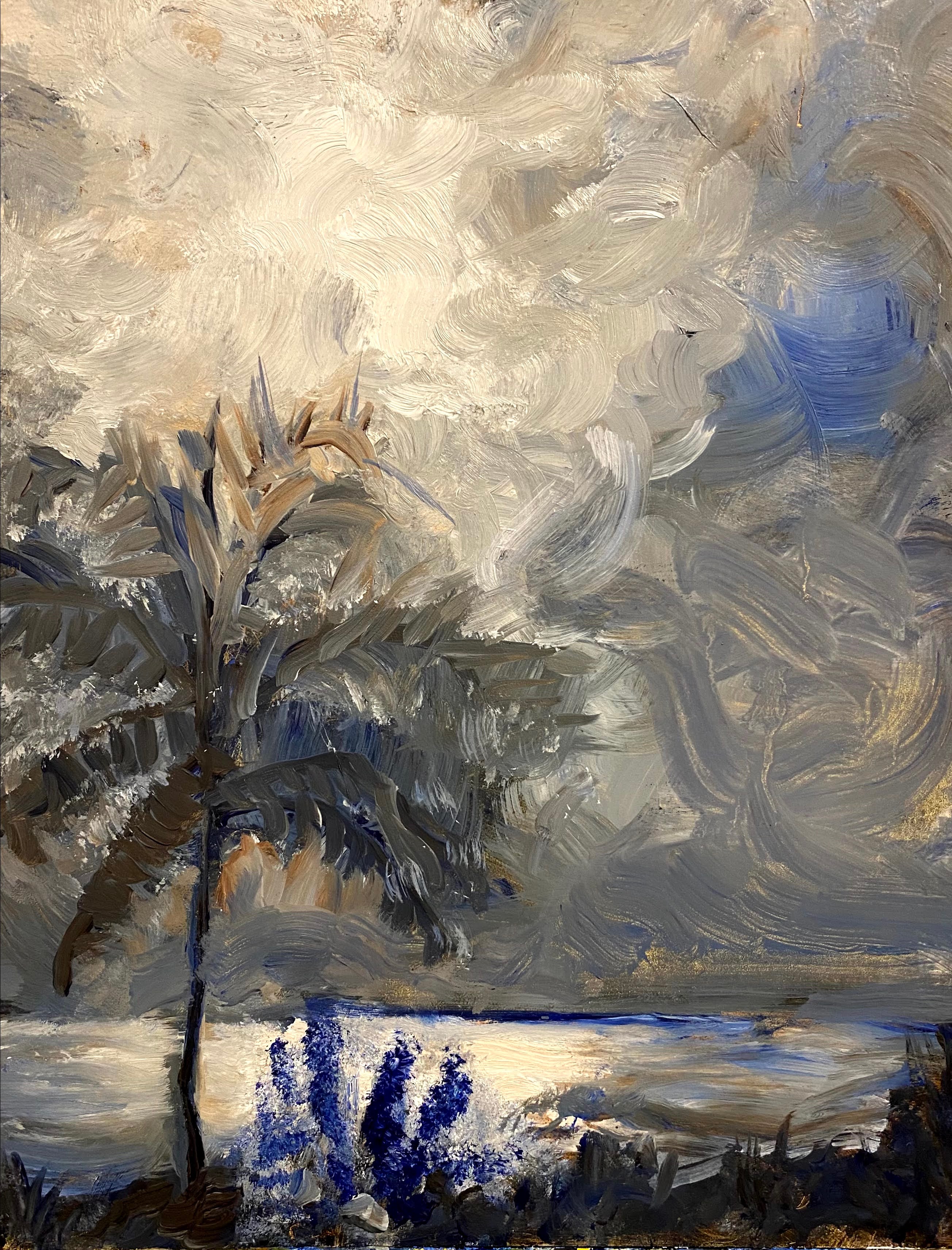
In the last six months, I have painted the same canvas numerous times, to reflect on my feelings during this Global Pandemic. It is an old, used canvas that I purchased at Goodwill for a couple of dollars. In the beginning, I painted the entire canvas white with Gesso and then began to use my oils to describe how I feel.
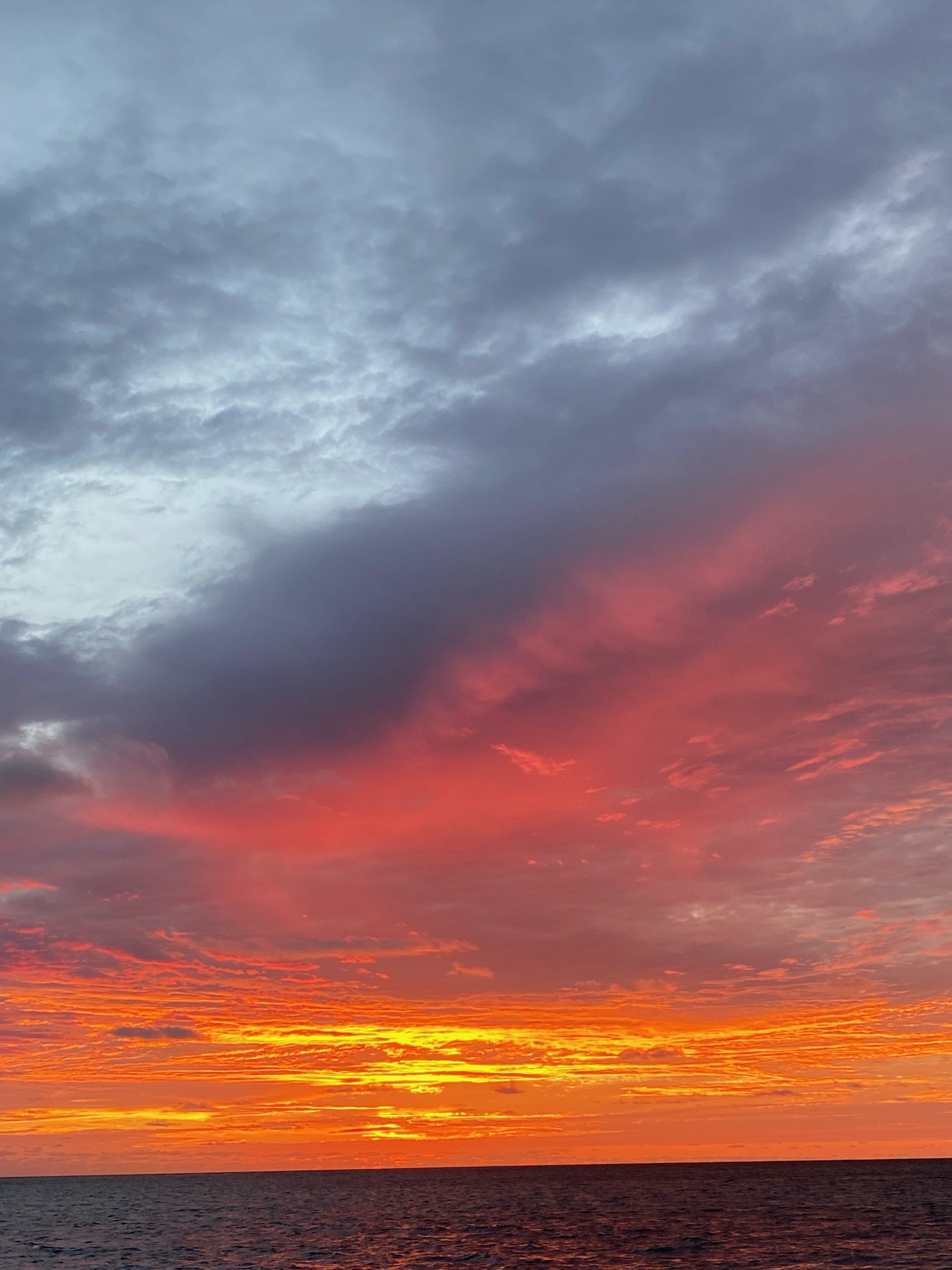
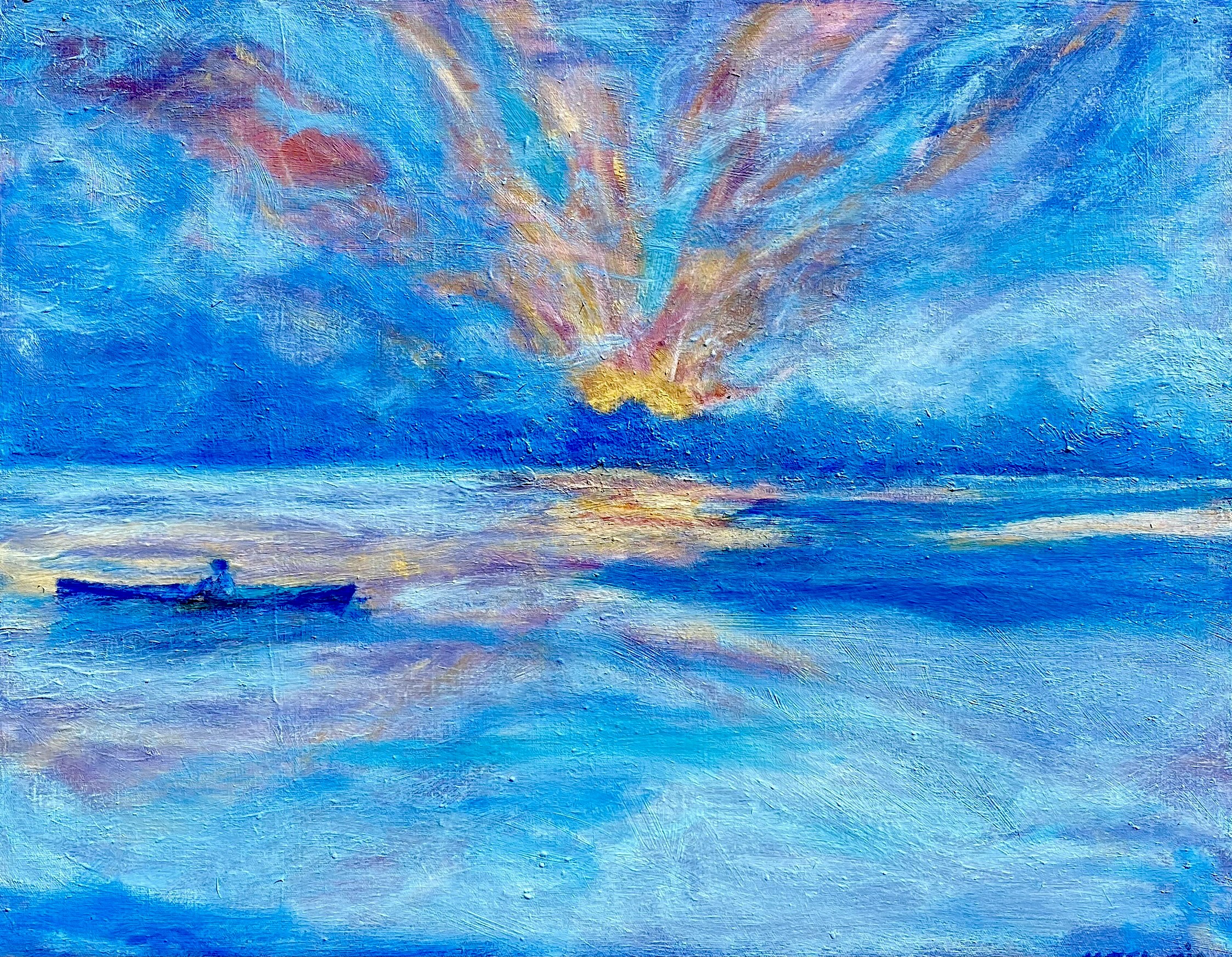
It all started with a celebratory painting filled with color and exploding with light, when things were looking good, the first major surge of COVID illness subsiding, people standing in long lines to get vaccinated, distances softening and it looked as though the pandemic was coming to a conclusion….but
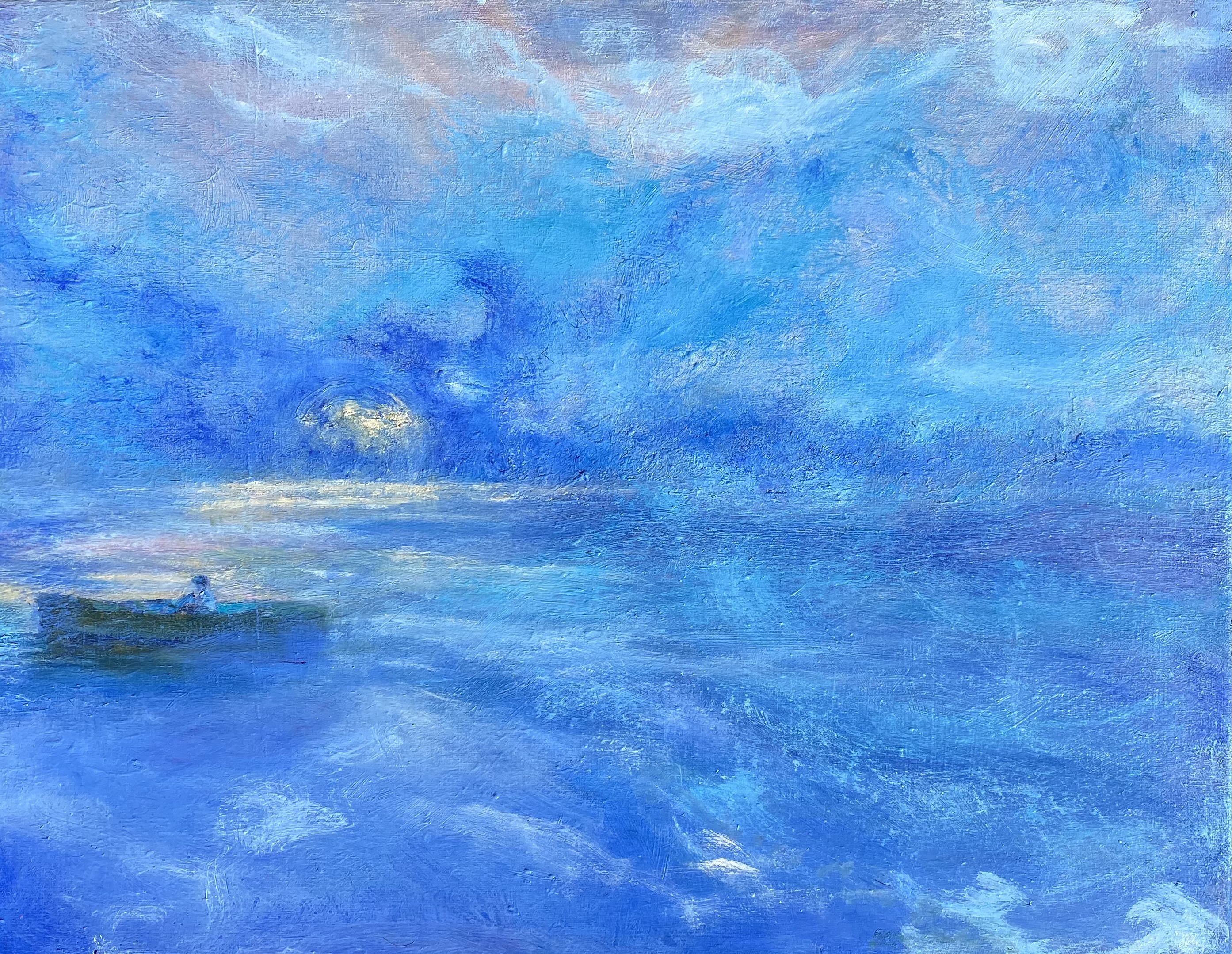
Early Sunrise
It followed with a shift in color and emphasis based on the fact that there was a significant portion of the population refusing to be vaccinated even when vaccines were offered for free. Ironically, there are numerous individuals in other places eager to be vaccinated, without any access to vaccinations at all. The blues began settling in.
The Blues
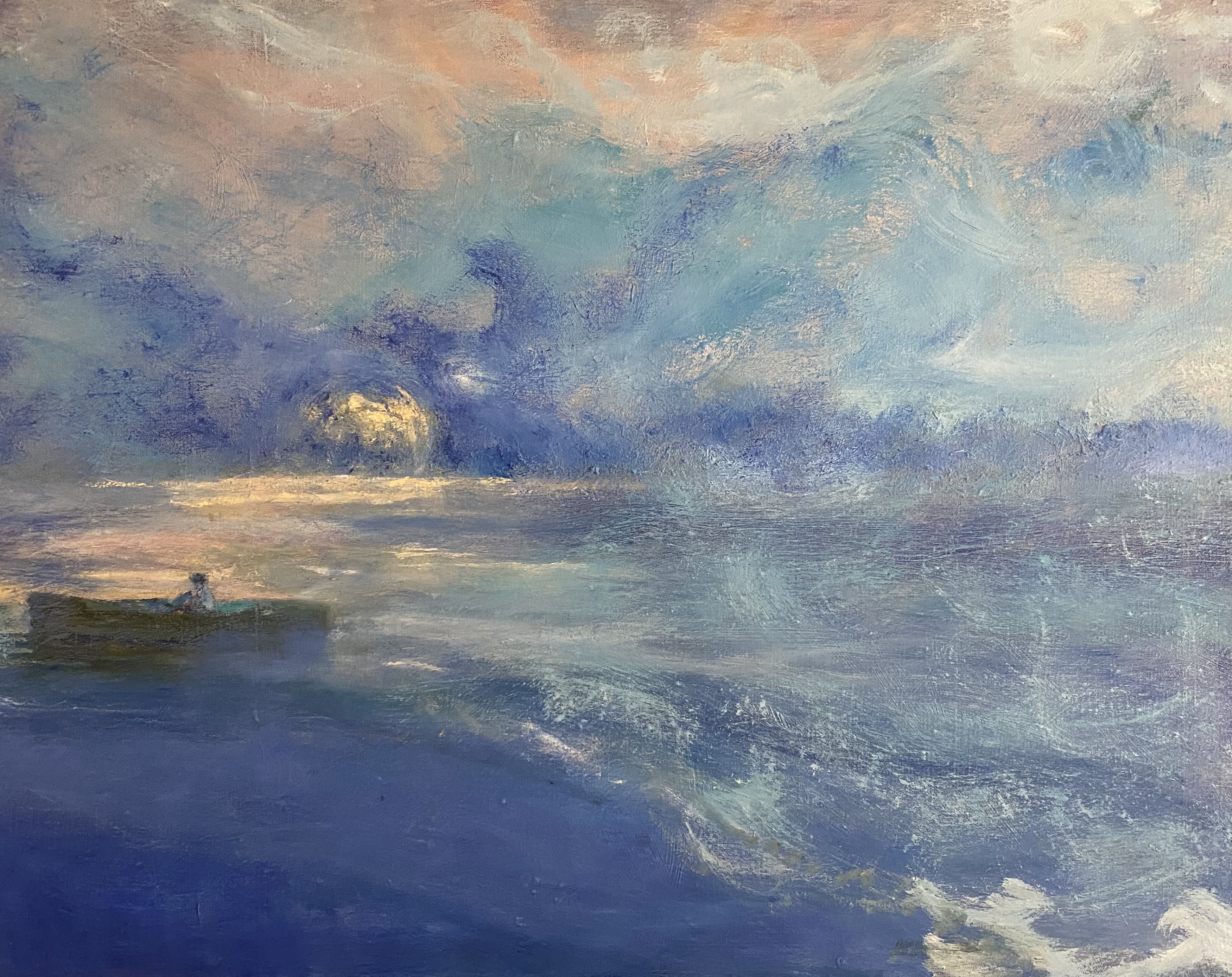
Pausing with bright colors to consider whether the fog will ever lift, whether we will ever make it to the other side of this global pandemic, whether it might be better to soften colors and expectations even further.
Fog Settles In
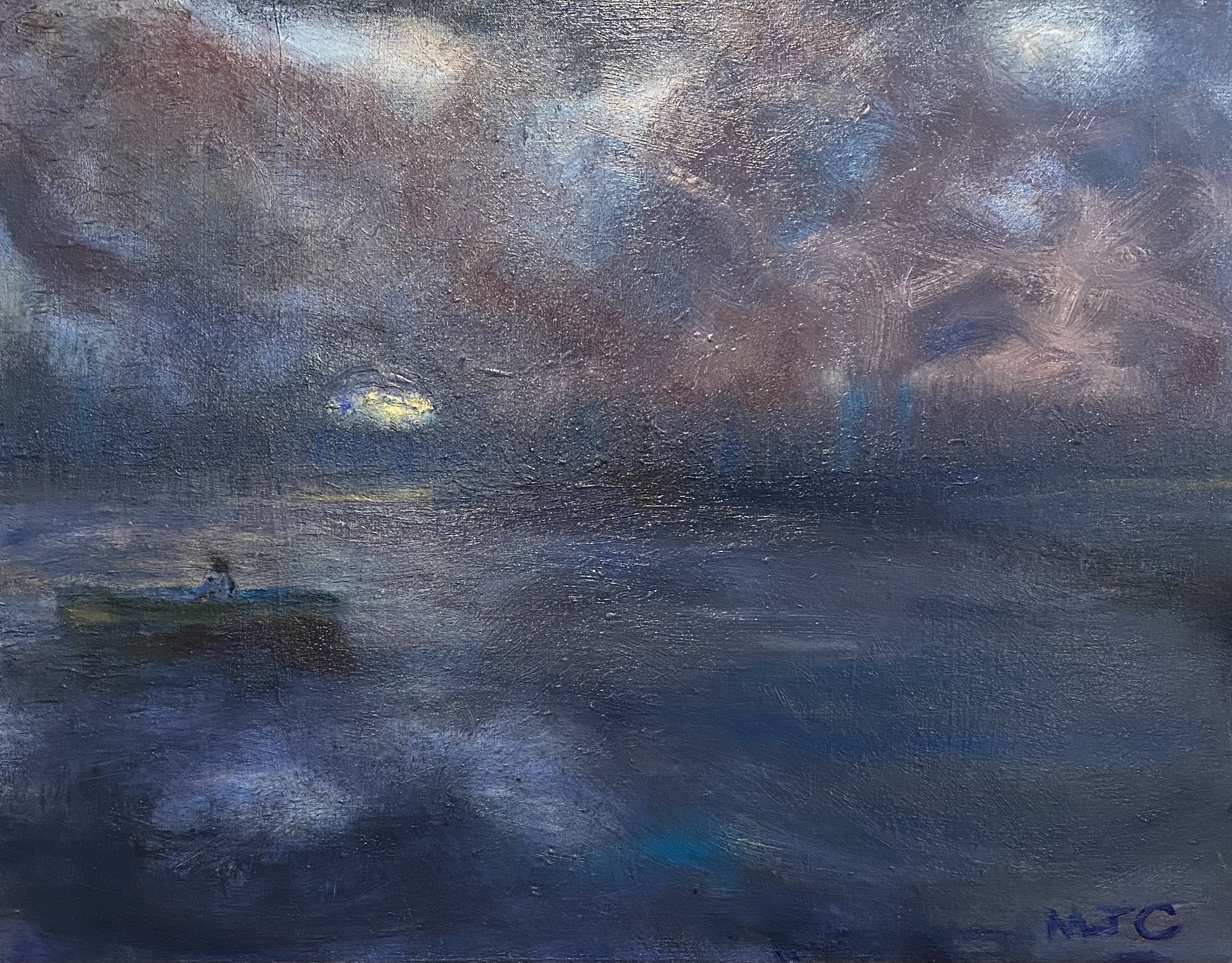
Gliding softly into sadness about what would happens next, darker blues, softer light, yet still appreciating the silence of ever shifting remoteness.
Night of Darkness
Stuck in gloom as reality hits hard, floating in dark waters, far away from realizing the end of the pandemic. Many more lives are unnecessarily lost, years of schooling missed, food sources cut short, distribution systems weakened, life expectancies shortened, quality of living amended again, even farther, bending to the severe isolation and rapid surge of hospitalizations and deaths, mostly of the unvaccinated, during the pandemic.
Doomed
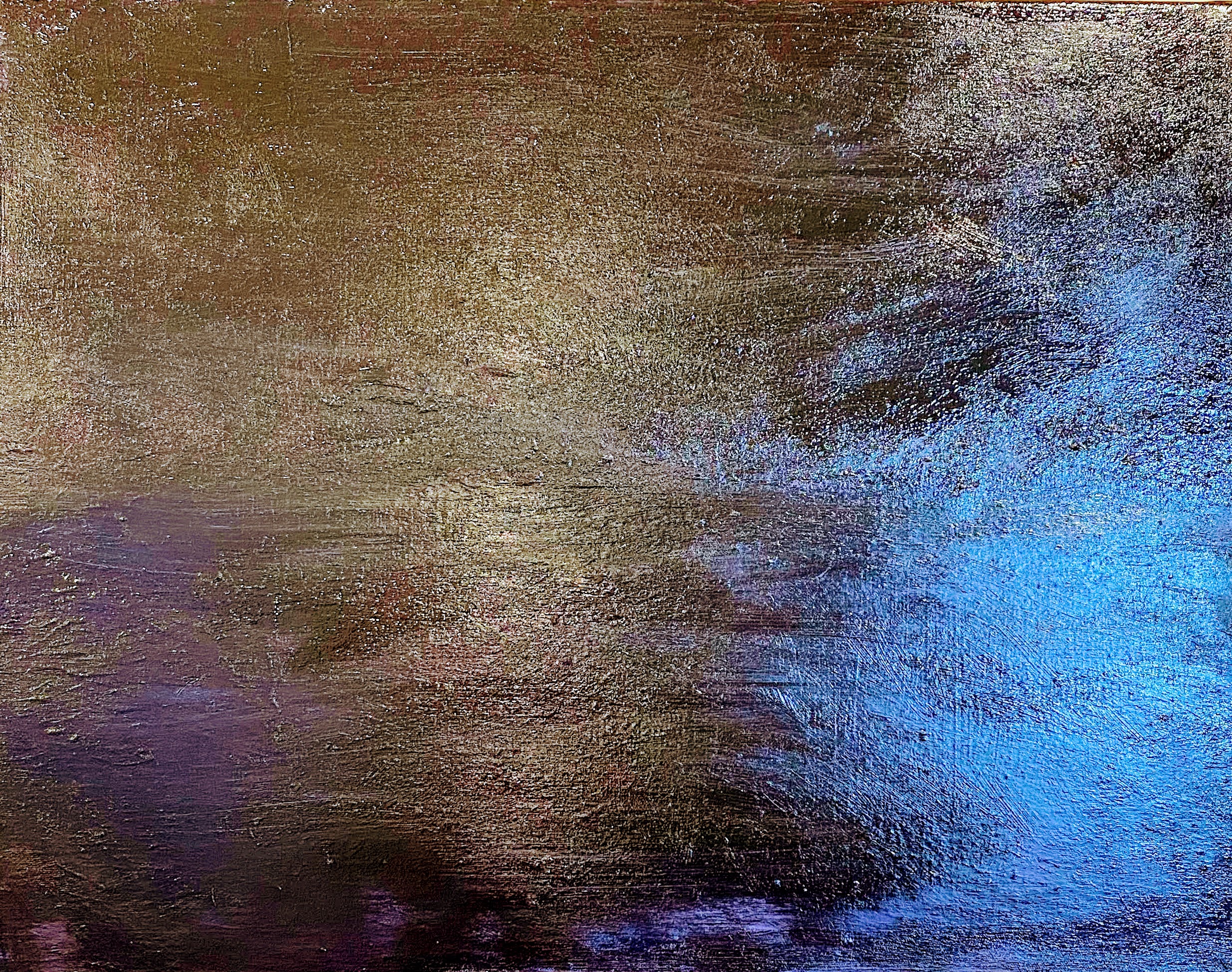
Hope is lost, the painting reflects on shapeless darkness. In some ways, this particular painting was very satisfying, as I lost myself in the darkness covering the entire canvas in dark blacks, reds and blues.
Then, the painting returns to shape and form, but this time, without much sentimentality. This time, it is based on the assumption that life is short, and that today is all there is.
My conclusion? Any painting we may do about this pandemic is true to life, each varied color and mood may be augmented for differential emphasis on our interpretation as to how things are going.
Not a Chance, But Life is Short
These are my ups and downs of painting during a global pandemic.
I hope that you enjoyed this reading these short notes on painting my way through pandemic blues and may consider sharing your own experiences on this notably historical event as well.
We may no longer write long paper letters, but we do know how to blog our way through tough times.
Winter Bridge, Oil Painting, 12″ x 16″ birchwood canvas
Here she is, my winter bridge painting. She has gone through a number of transitions, on her way to becoming. Now that she is here, I cannot imagine how she looked before.
I wanted the sky and water to mingle and reflect in this painting.. And I wished the Winter Bridge painting would highlight the Willamette River’s natural beauty while staying real to the sight of industrial pressures that such city rivers also bear.
I hope the viewer enjoys the sky, soft background hills the river flow and water reflections. I also hope the viewer considers the port side, the big buildings, the ominous boats that cover up the natural ridge of this beautiful river, dominating a once pristine cove.
May we never forget how this river flows so naturally under the bridge, the left bank tucked into trees and soft sky. And may we also remain concerned when we see that it flows on the other side, past the industrial messes we make.
We form a book club of two. She lives in NYC. I live in Portland, Oregon. The distances between us are magnified by the pandemic. We did not see each other this past year, as travel is severely limited by the ongoing global pandemic. We decided to share readings about pandemics of times past while staying in touch via the internet and phone. Each of us brought books and articles to the table and our first reading list looks like this.
The Great Influenza, by John Barry; The Plague, by Camus; Year of Wondersby Geraldine Books; Pale Horse, Pale Rider by Katherine Anne Porter.
The books we choose tell stories of pandemics occurring in the last 400 years. We read of plagues and pandemics between the years 1660 and 1918, seeking to understand the one in 2020. The stories we read might just as well have been written about the plague we confront today. Reading them is proving cathartic. It is somehow reassuring to learn of other pandemics, of plagues past, and how lives were lost. Yet eventually, the incidence of illnesses and deaths subsided and things went back to normal. That is, if you can call enormous loss and experience with paralyzing fear, normal.
Previous plagues did not subside without stress, tragedy, conflict, pubic protest, political in-fighting, devastating illness and untimely death, family upheaval, lonely migration treks, escape attempts and economic loss.
It is clear from these stories that there are ways to prevent or reduce the numbers of deaths and illness even under the direst of circumstances. But it requires community cohesion, respect for the rights of others and acknowledgement of one’s community and family responsibilities.
During one of our discussions, I asked her, “Did you ever study the history of any pandemic while you were in high school or college?.”
She said, “No I did not.” I agreed with her that I did not either.
We both remembered references being made by teachers to a “plague” of some time or place, but what was missing was an historical description or analysis of what happened. We remember no required readings in our coursework of historical or fictional accounts about pandemics. Perhaps there were some readings and we did not take note of it, figuring such horrible experiences were all behind us?
Thus, it would seem that when our global pandemic was officially announced on March 11, 2020, we were not prepared. One would have thought that it was the first pandemic humans had ever experienced.
“It is happening over there, not over here.”
“It is their fault.”
“It will never get to us.”
“It will be brief”
“It will take a while”.
“It looks like it is increasing but it really isn’t.”
“It will be resolve quickly by medical technology.”
“It cannot be managed unless we all participate in this together”
“Data are being repressed”.
“Do you know anyone who has had it?”
“Do you know anyone who died from it?
“No need to change our behavior.”
“Our rights are being taken away.”
“Our responsibilities are too many.”
“I am so sorry for your loss.”
“Glad that you are feeling better.”
“Will it ever end?”
“It feels like it is coming to an end, but how can I be sure?”
“We have a vaccination, now.
“When will I get it?”
“For how long must wear masks and stay socially isolated?”
As time marches on, the seriousness of what is happening cannot be ignored.
What can we learn from reading books about pandemics? I would say, just about everything. Through books and book discussions we can start to come to grips with what happened. Reading these stories offers a better understanding of how we might cope. It offers a way to imagine our future during these bleak hopeless times. It suggests the healing process that we must go through when the pandemic subsides.
Below is a Poem from the Irish Times sent to me by a friend of mine.
When, by John O’Donnell
And when this ends we will emerge, shyly
and then all at once, dazed, longhaired as we embrace
loved ones the shadow spared, and weep for those
it gathered in its shroud. A kind of rapture, this longed-for
laying on of hands, high cries as we nuzzle, leaning in
to kiss, and whisper that now things will be different,
although a time will come when we’ll forget
the curve’s approaching wave, the hiss and sigh
of ventilators, the crowded, makeshift morgues;
a time when we may even miss the old-world
arm’s-length courtesy, small kindnesses left on doorsteps,
the drifting, idle days, and nights when we flung open
all the windows to arias in the darkness, our voices
reaching out, holding each other till this passes.
Landscapes we paint, no matter how big or small, are wondrous moments witnessed through our abstraction.
When thought of this way, there is nothing real about a landscape, other than the fact that light is shifting, objects are reflecting and atmosphere hovering, and we experience constant movement of ideas and thought, while traveling through these variable, natural compositions.
Nature is for painters, our most wild and beautiful challenge. Lucky for us, nature is everything, and we have many opportunities to paint, to write, or simply observe its amazing show.
There is no right or wrong painting or poem as all abstractions are personal.
Knowing this, brings freedom of our own thoughts and choices of shifting moments we remember.
These are my notes for paintings that I am working on in an art course on The Value of Design taught by Michael Orwick through the Oregon Society of Artists
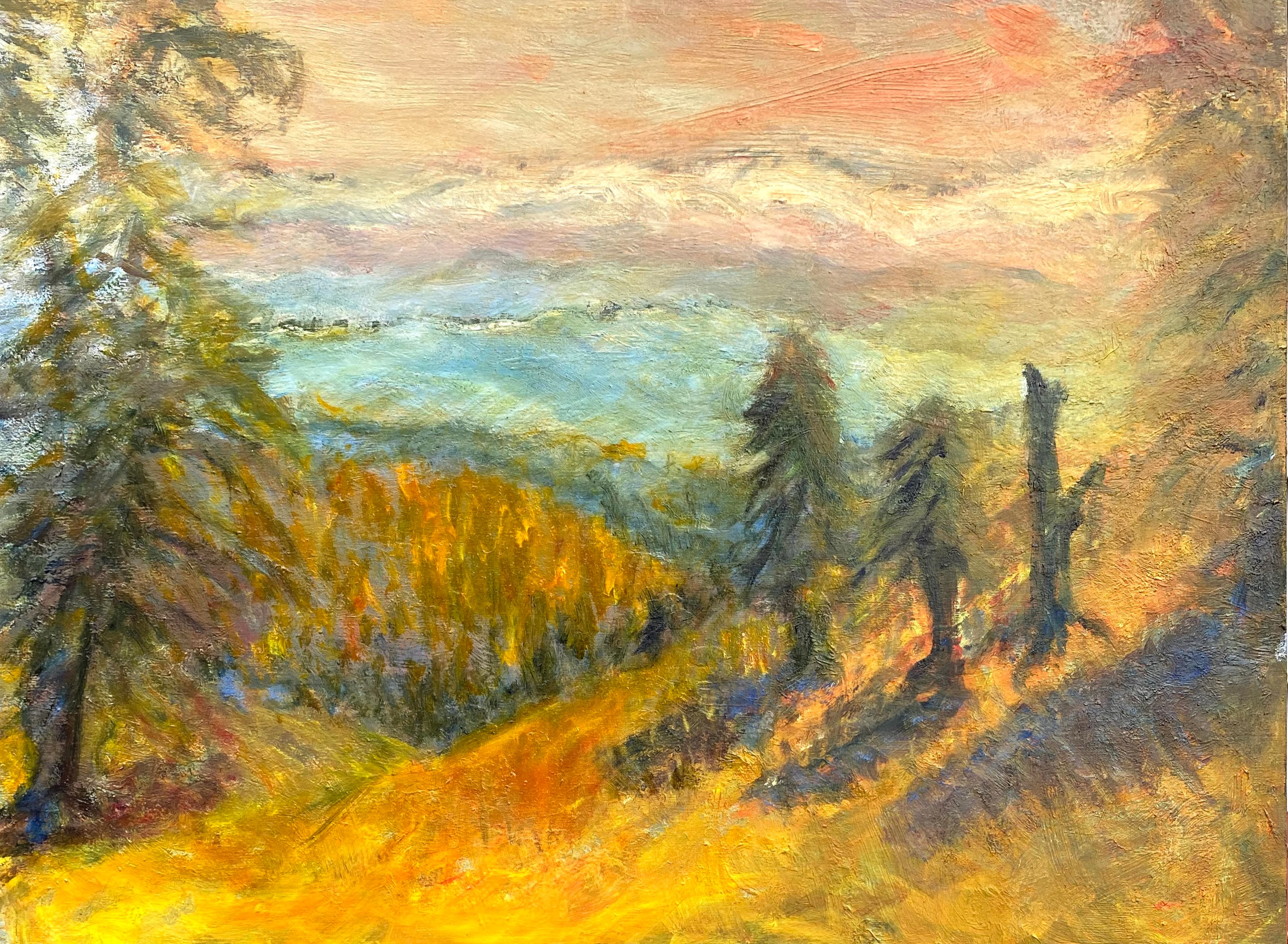
I started this fourth week by finishing off a painting of the Oregon mountains, using a tonalist style. I liked working on tonalism and decided to continue using this style for our next assignment.
Our goal is that by the end of the fourth week of this class to complete a painting while going through all of the steps we have learned thus far.
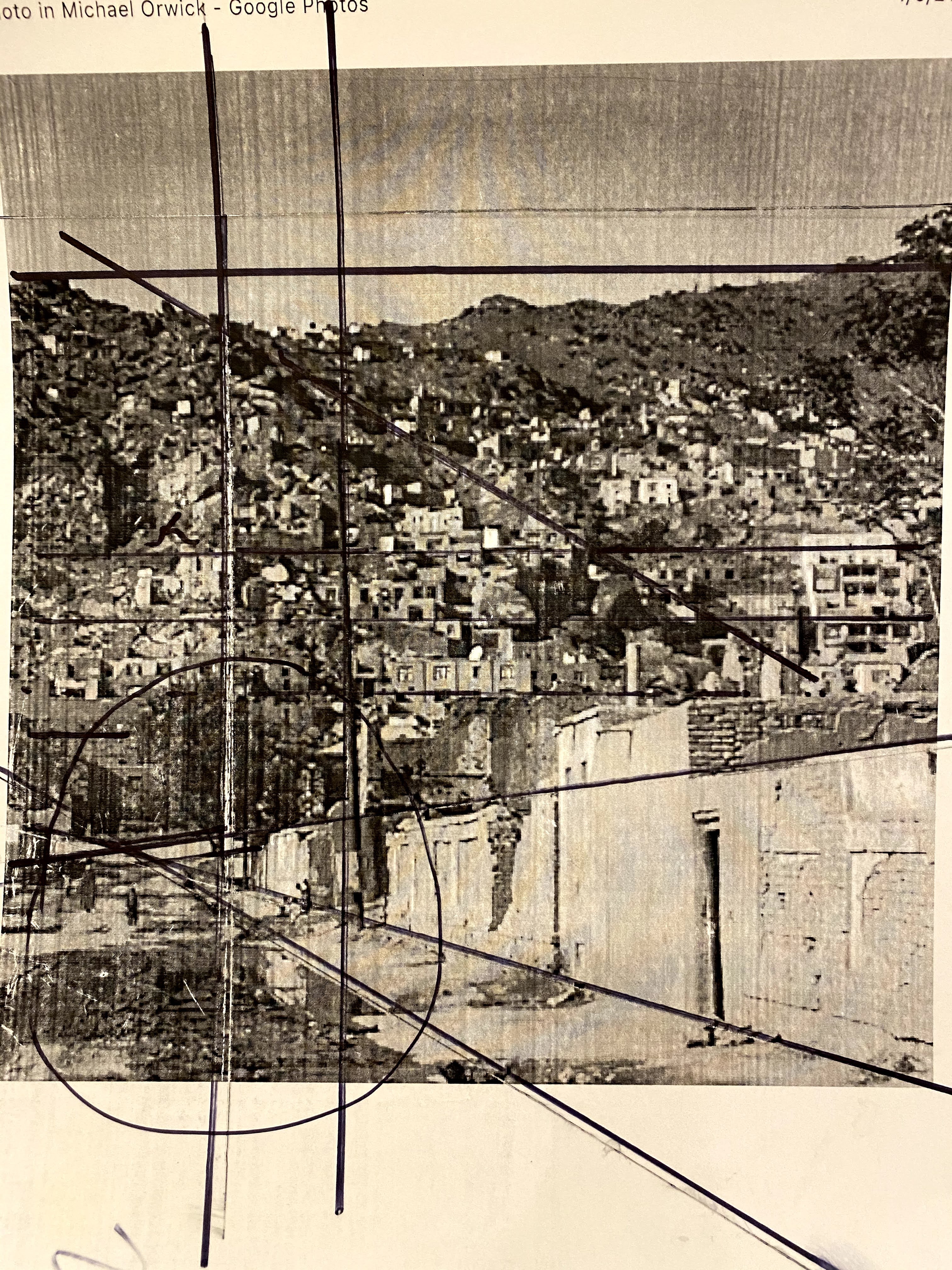
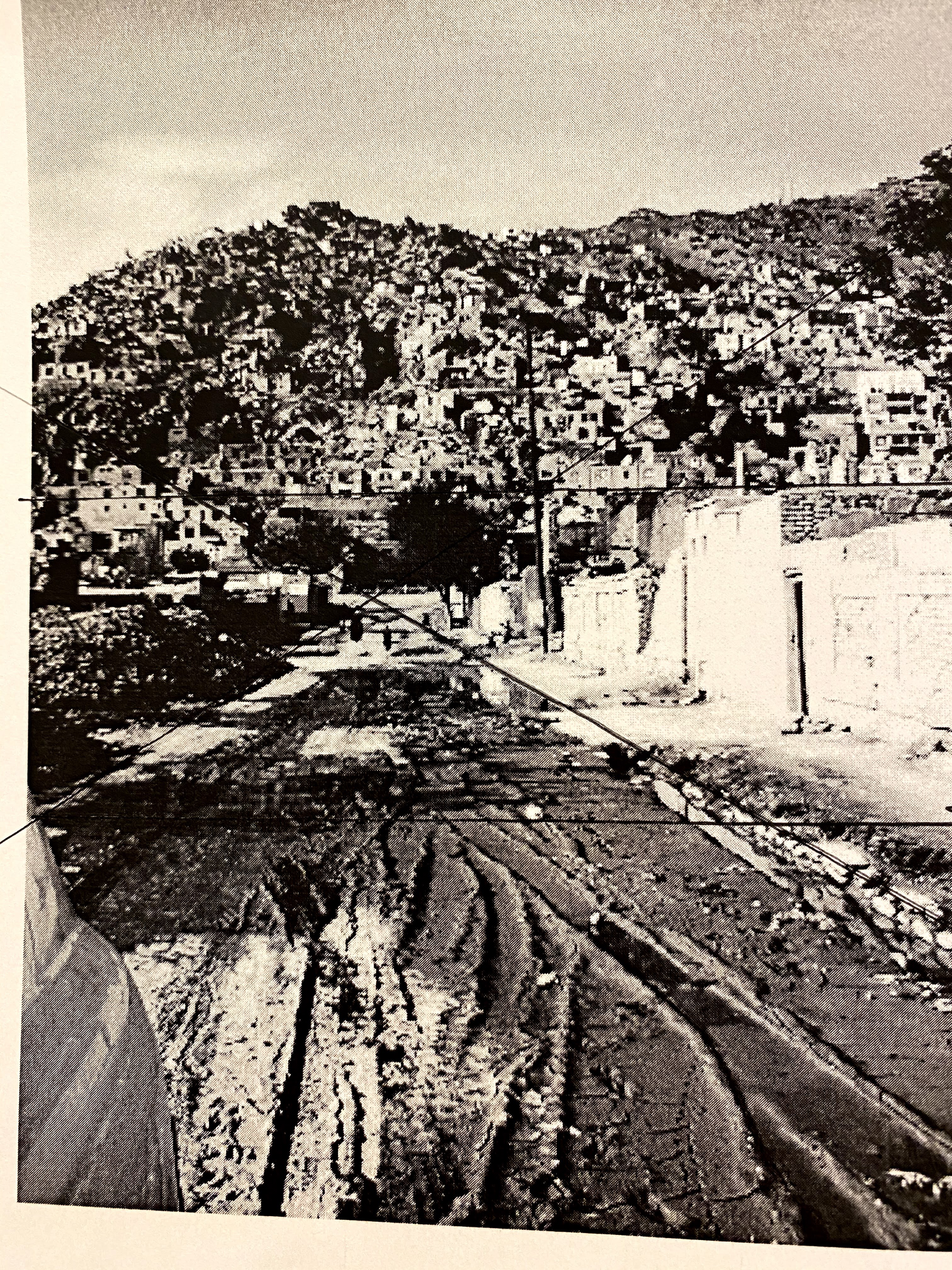
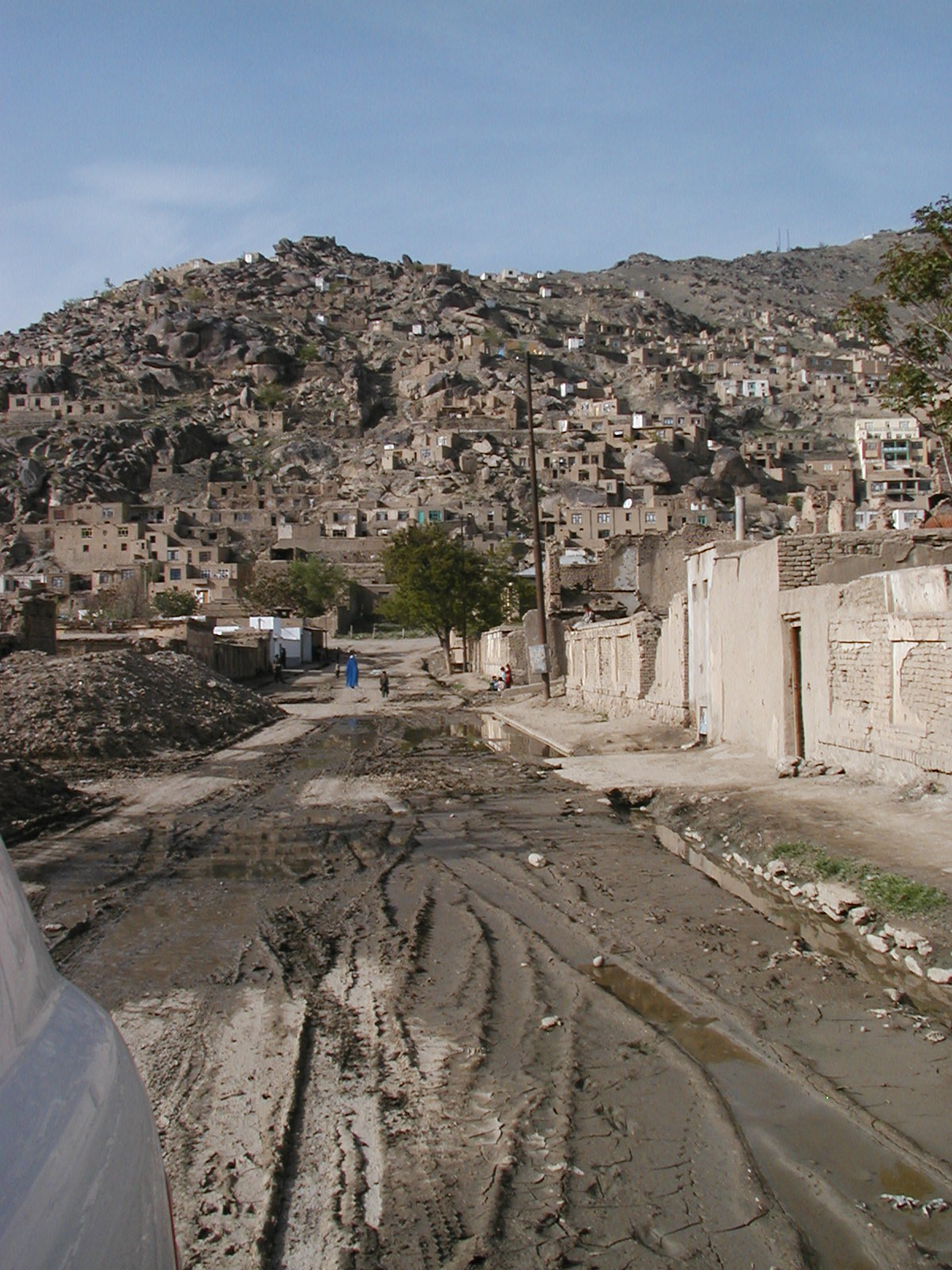
For this assignment, I choose a landscape photo that I had taken while in Afghanistan for my next painting.
In May 2003, I led a United Nations statistical mission to Afghanistan in order to review a proposal for a census program for the war-torn country. Our team worked on this project for several weeks. The team was comprised of national statisticians from a number of countries, staying in a relatively secure location, but still very aware that we were in areas where heavy fighting occurs. It was a complicated mission, with difficult decisions, yet we could not but look up from our work and around at the ancient beauty of this city, this country, gateway to Europe and Asia. Kabul is a city of many languages, many ethnic groups, many years of sophisticated history.
It is worth noting that the earliest example of an oil painting was found in Afghanistan in caves near the ancient Buddhas that were recently destroyed by the Taliban. Scientists confirmed that some of the paintings were completed in as early as the fifth century, long before any other civilizations used oils for painting. The art history of Afghanistan is long and fascinating.
Looking up into the foothills surrounding Kabul, I cannot tell where the housing stops, and the hills begin. The soft tonal colors of the boulders up on the foothills mix with the angular shapes of homes. Higher homes have been hastily built as safe havens from street fighting occurring below. They are built at times without the privilege of electricity or septics, some with only walls up, windows and doors still hollowed out. Homes, to hide in, to tuck away in, as war and street-fighting have torn at this nation.
Our class has been discussing the art of tonalism, and since I wanted to paint a landscape, I decided to try working on a picture of an Afghani settlement in the foothills of Kabul. The soft pastels that of Afghanistan’s hills and valleys are often dotted with the bright blues of women’s robes (burkahs) as the women often wear them when walking outdoors in public. Soft greens of trees and fields are seen in the valleys of the Hindu Kush Mountains, often cut by a moving mountain stream flowing through. If one sees soft beige, slight pinks and purples, the observer is probably looking slightly upward at the foothills and the homes made out of a combination of handmade bricks, soft grey-brown mud, and some cement often sheltered by grey and purple foothills. The shockingly high mountains are differentiated mainly through varying shades of white snow, which I was not going to depict in this painting.
In a previous blog where I sketched out my plan, I decided to name this painting “Upwards”. I chose that title because upwards seemed to be where everybody was going. I thought I should photograph the two distinct kinds of urban settlements we mainly saw. There were those that were settled into the valley, and those headed “upwards”. We needed to learn as much as we could about Afghani settlements, as census-taking, world-wide, still includes the ancient science and art of counting and recording characteristics of every household and individual in a country.
I started with a copy of the uncut, unedited photo that I used for my inspiration for the painting, I do not plan to follow the photo in its entirety, but wish to use it as a reminder of how I felt at the time. My husband Joseph and I had lived in parts of south and western Asia for a number of years, and this place felt familiar, and welcoming to me. It is an amazing amalgam of a number of nearby cultures from the ancient lands of Persia to the Bay of Bengal.
In the process of deciding what aspect of these settlements to paint, I played around with photo cropping and sketching in order to see the big shapes and values better. I also hoped to highlight an Afghani woman walking with a child, her bright blue burkah flowing around her. It is always such a contrast with the softer colors of the streets.
Had I chosen to paint the entire photo, I would have used a diamond shape as my big shape, as seen in the slide show above. But instead, I placed the woman and the little boy off to the side, letting the light come to them. This made the larger shape of the painting more like a Z.
The spilled water on the road was a challenge and I wondered how to include it pouring down the open gutters and into the street, leaving reflections of nearby buildings, rather than the usual flowing rivers that slip through natural landscape paintings.
I started by sketching a variety of scenes, from a simple notan to short sketches of what I hoped to paint. From these sketches, I began to see a clear pattern of shadows highlighting hill homes and big boulders that cover the sides of the hills. I feel that it is important to simply this picture while still keeping the feeling of what it was like to be there.
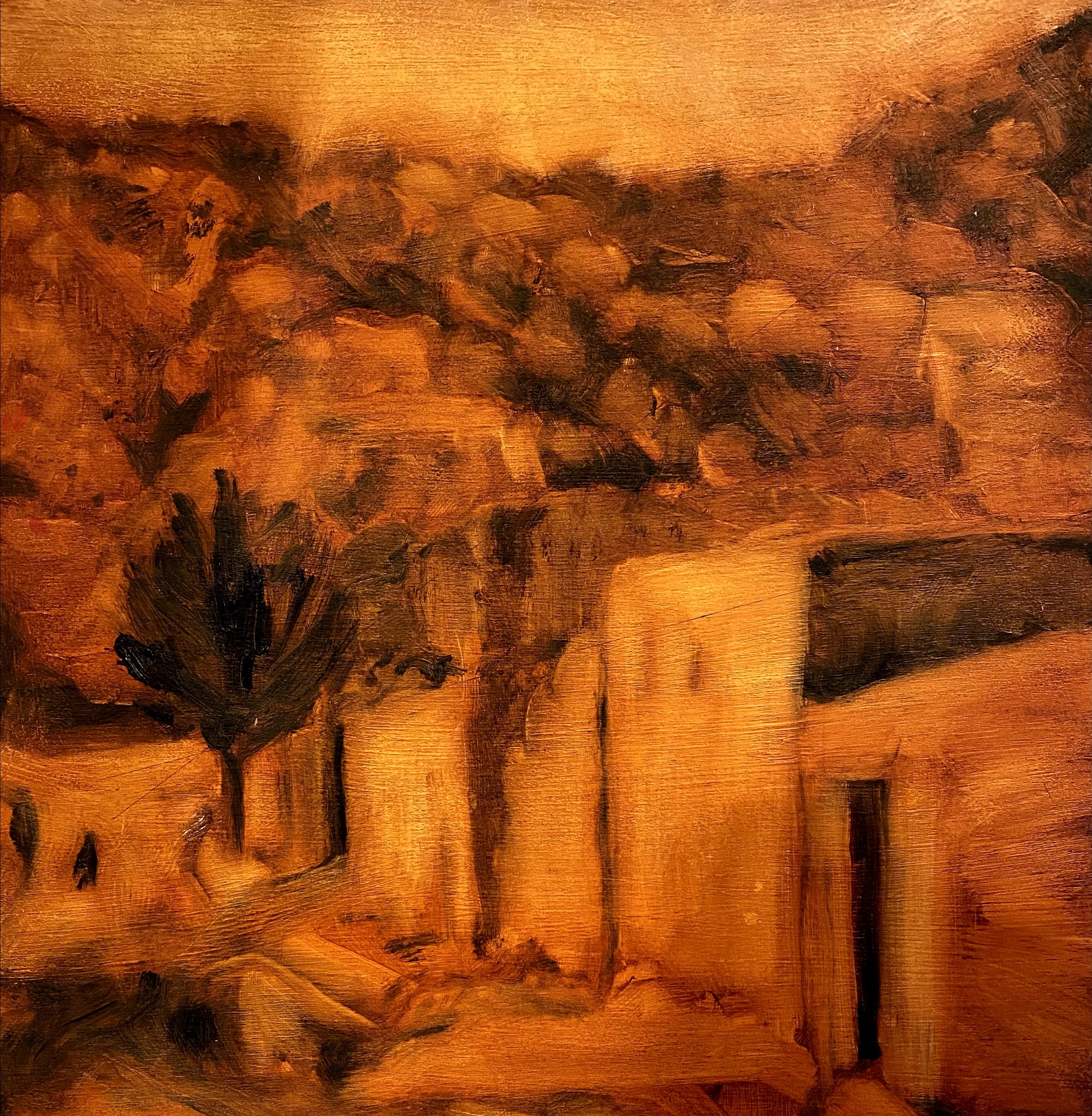
At some level, I liked it so much I didn’t feel like adding any more paint. But, given that this is a learning device, once it was dry, I proceeded to the next step of adding oil colors over the sketch. I am hoping also, to keep the wood grain of my birch wood canvas showing in the painting, when it is useful to the scene.
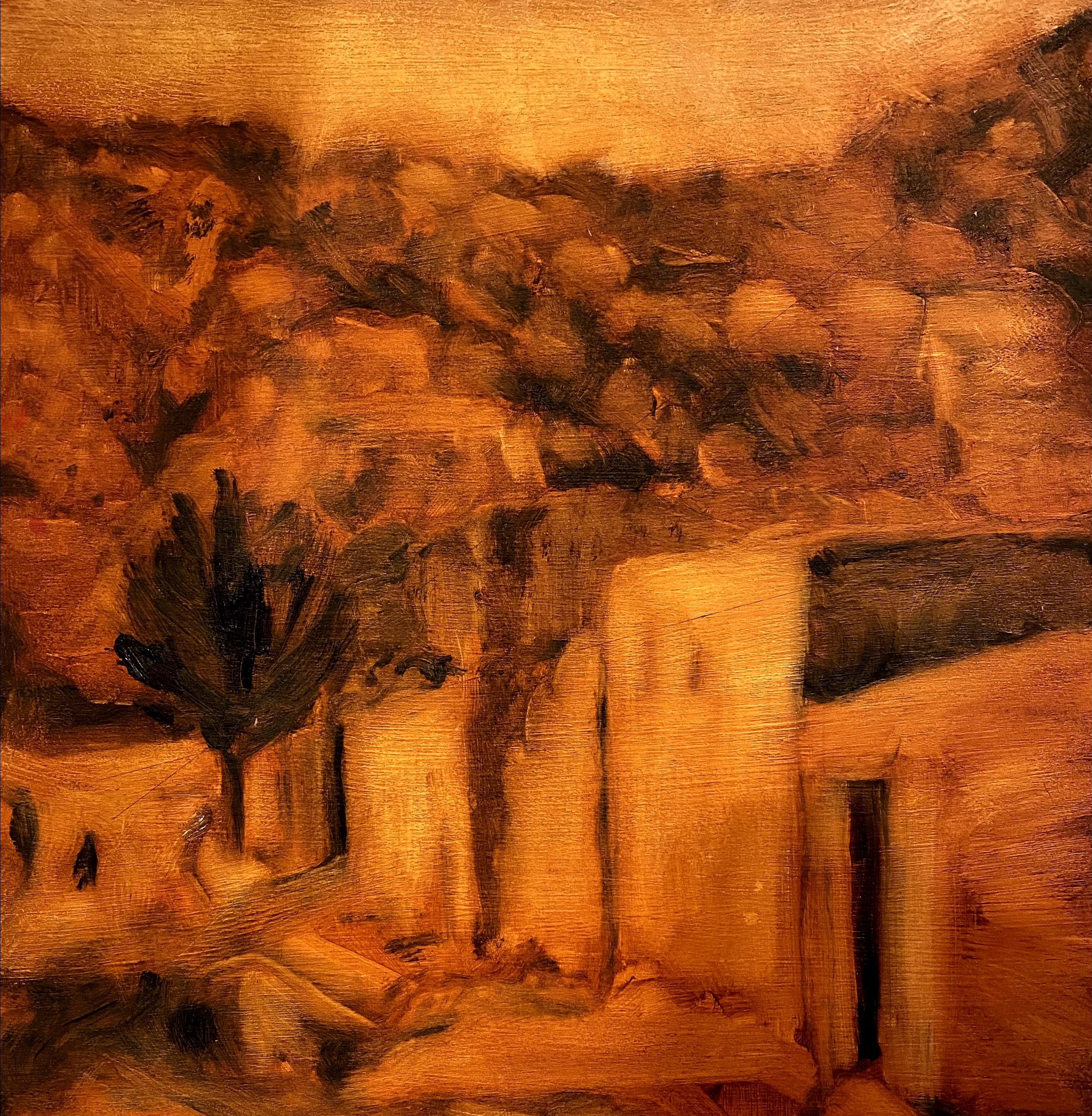
Using the method we had earlier learned of placing transparent paint onto the canvas and then using rags or paper towels to remove some of the paint to leave big shapes and values, I ended up this this sketch for my intended oil painting.
“Upwards” oil painting,
This is as far as I got with the idea this week. No doubt, I will work on it some more after it is completely dry. I am interested in trying out various glazings, perhaps an earth red and a mixed blue-grey, to soften some of the bright pink hues of the foothills.
Home is by definition the place of our hearth and shelter. It may be as simple as a tent, or as complicated as a 20 story building, but it is still home when it offers hearth and shelter.
Since the pandemic was declared, home is a larger place than just where we stock our supplies and conduct our activities of daily living. We also go to work, to play, or to school while at home, express our joys, share our sorrows and declare our dreams at home.
Home is our atmosphere, our existence, our nook for survival. It is our island of safety and hope.
Home is where we express our despair and agonize over the future. Home is all that we have, if we are lucky, until the world learns how to manage the global pandemic.
May we never lose our homes. For those who have, my heartfelt sympathies. We must work to get them back for you.
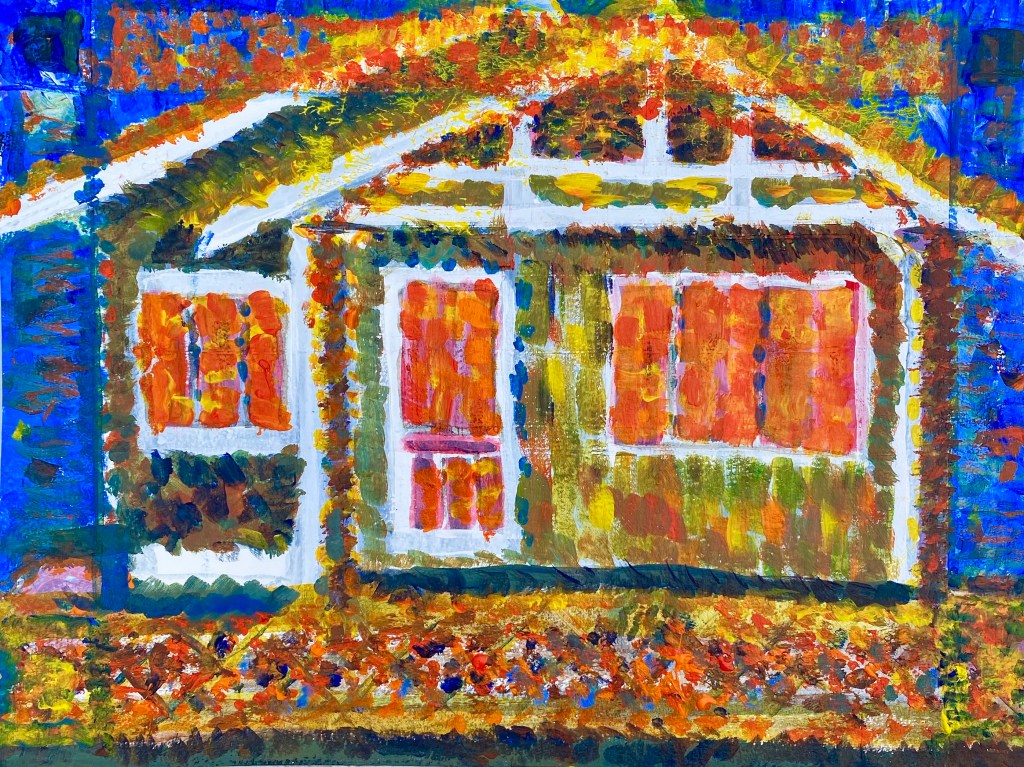
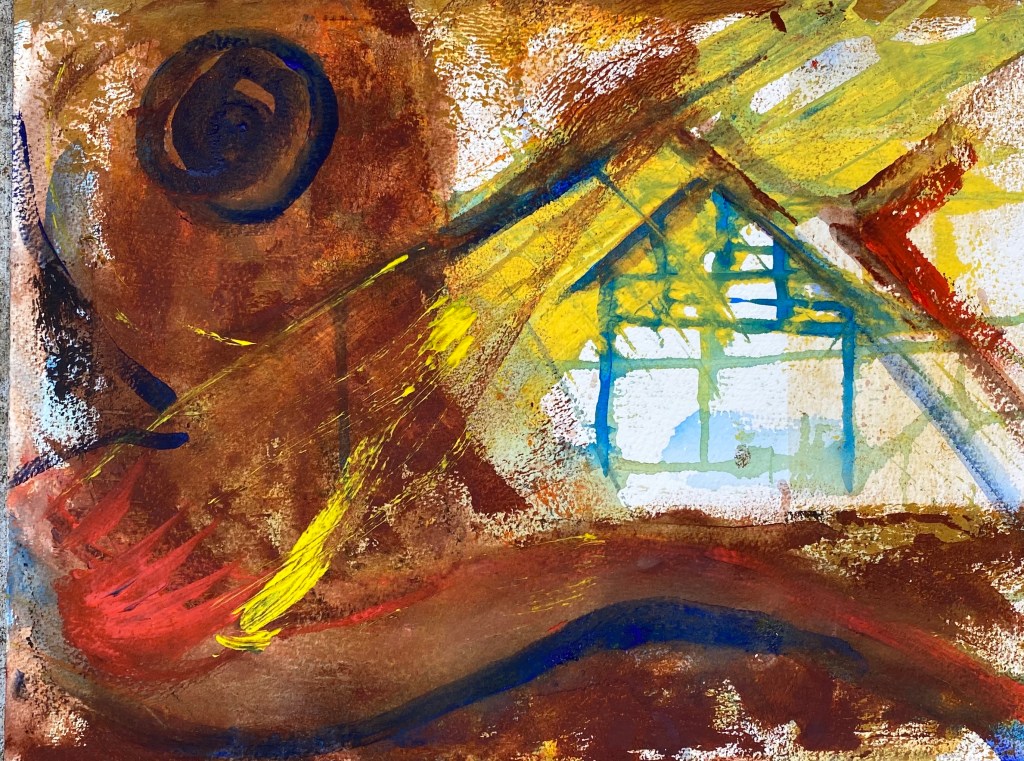
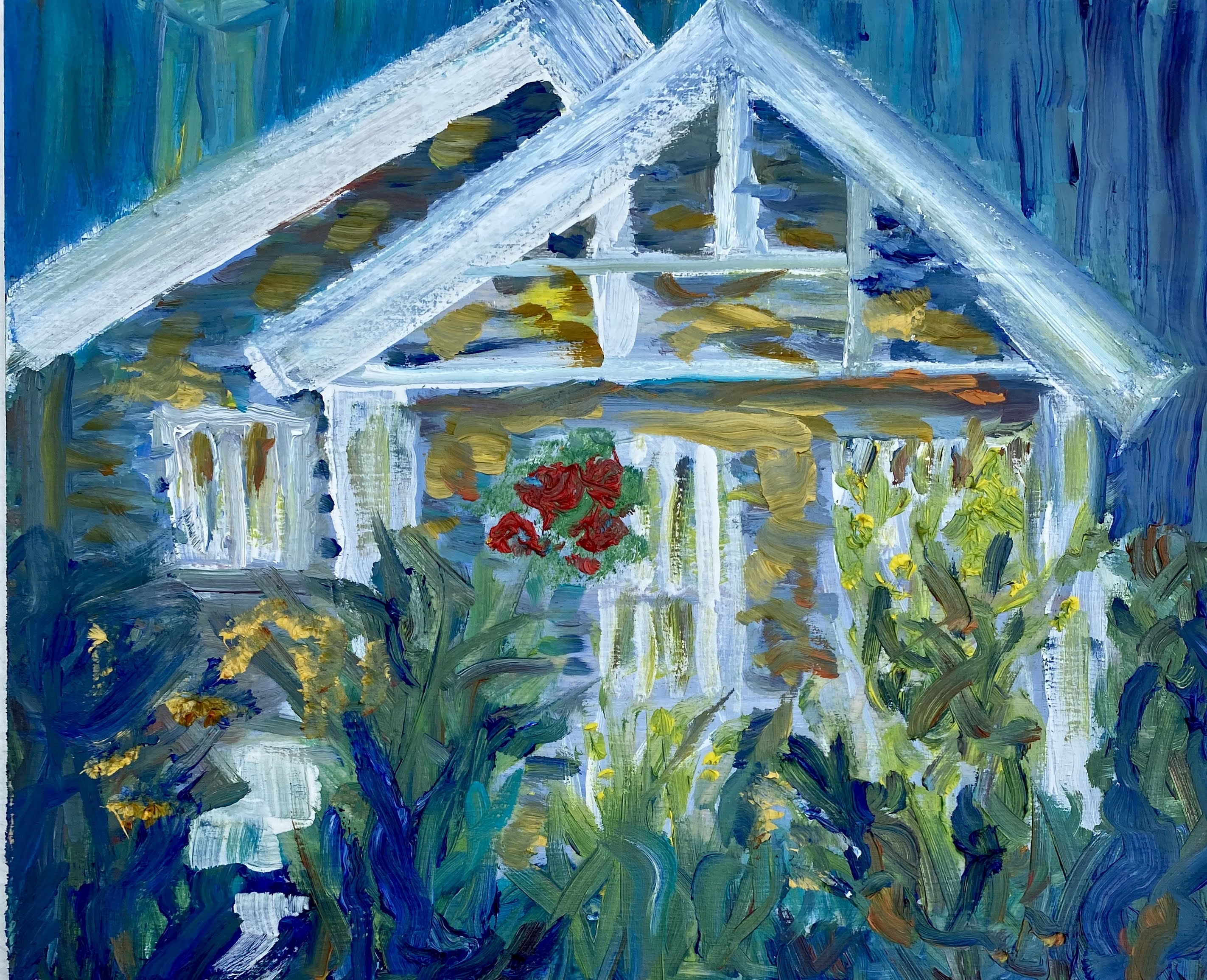
I express my appreciation for home by painting a variety of perspectives on our little bungalow to which we recently moved, while depicting the change that we have gone through as we increasingly realize that home is the center of our universe.
We are world travelers and for us to circumlocate to such a small area as home and consider it our major place of stay, is quite a change. But adapt we must, and adapt we are. One way that I am adapting to this smaller area, is through art.
Festival House, acrylic
Perhaps it appears silly to see a tiny home drawn with Roman Columns constructed out of colorful marble, looking garish and far removed from reality. But this painting reflects for me, the home as the holiday, the celebration, the festive tradition.
Home as Safe Haven, acrylic
Home is where we hide when it is dangerous outside. It is the cool blue in the chaos of reds and yellows.
Looking through a microscope changes ones perspective on what one sees in a cell. Focusing on one’s home does something similar. It was always there for us to discover and the pandemic is increasing our attention to it.
I plan to paint many more pictures of home in these upcoming months, while looking at it anew, as through a microscope.
Evening Perspective, acrylic
Thank you home, for offering such a safe haven for so many of us during a time of panic and dread.
 Oregon Coast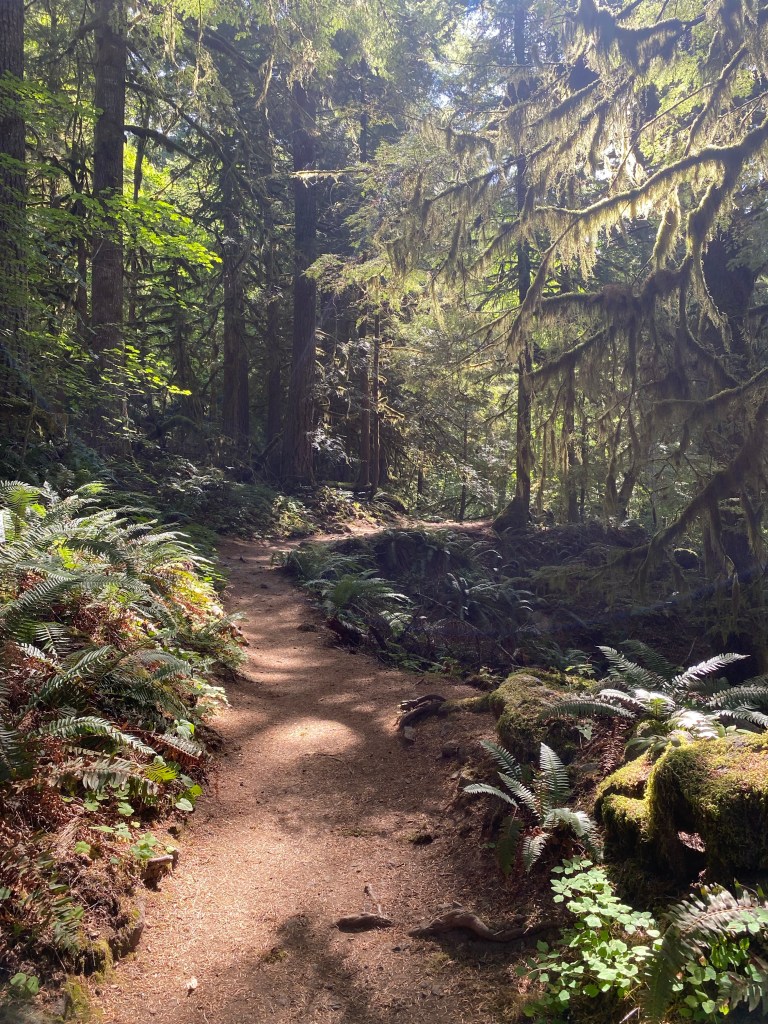

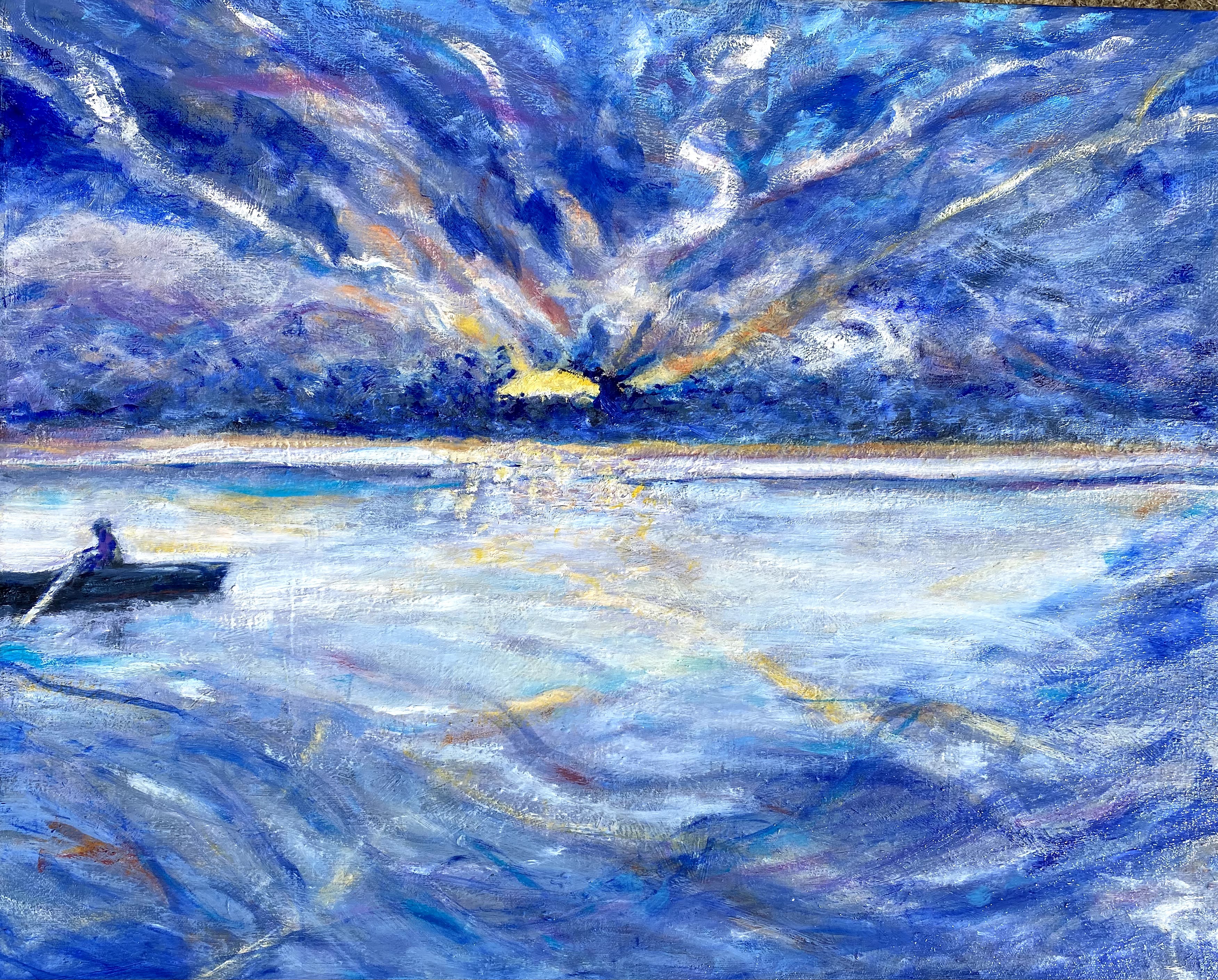

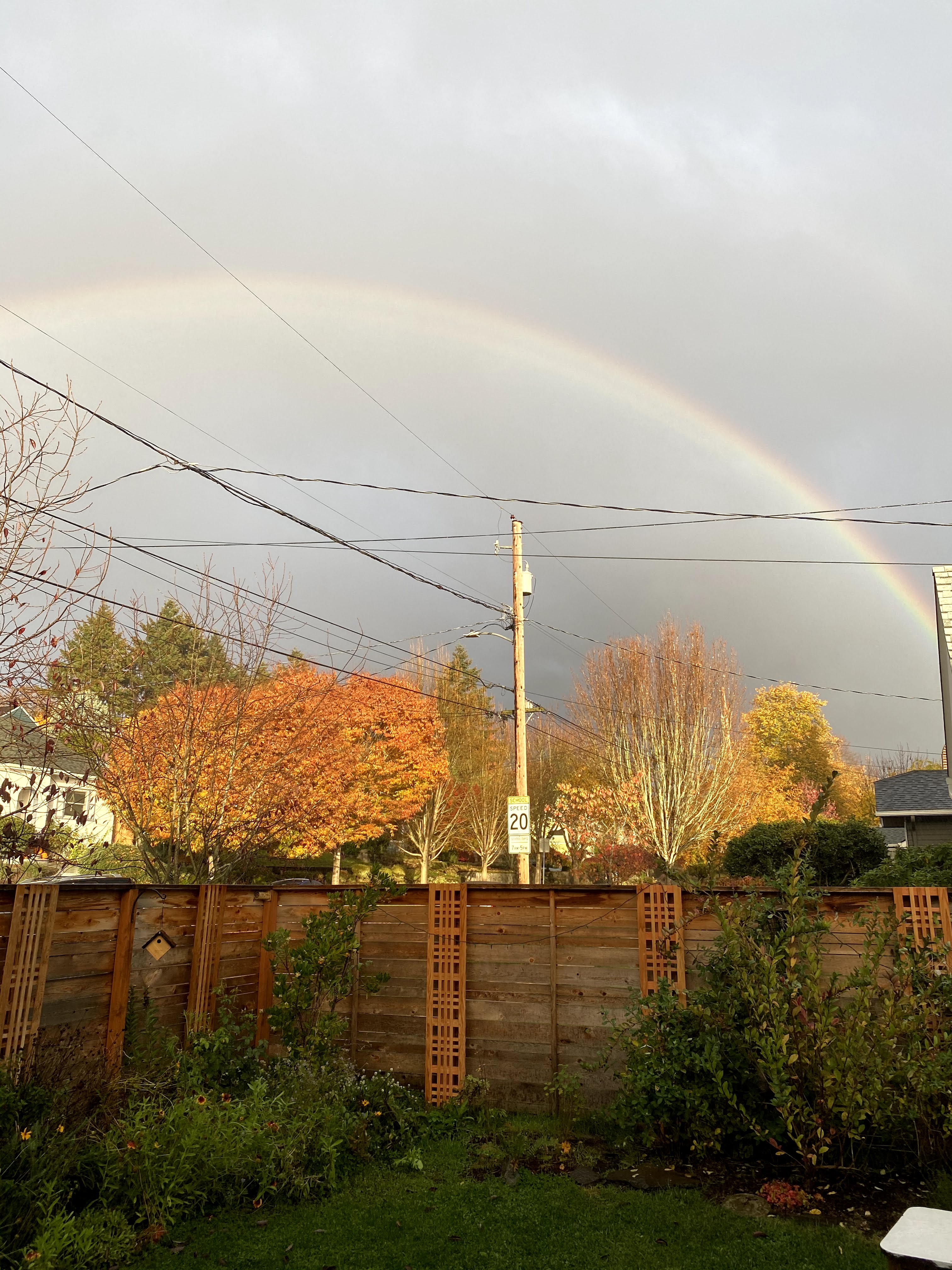
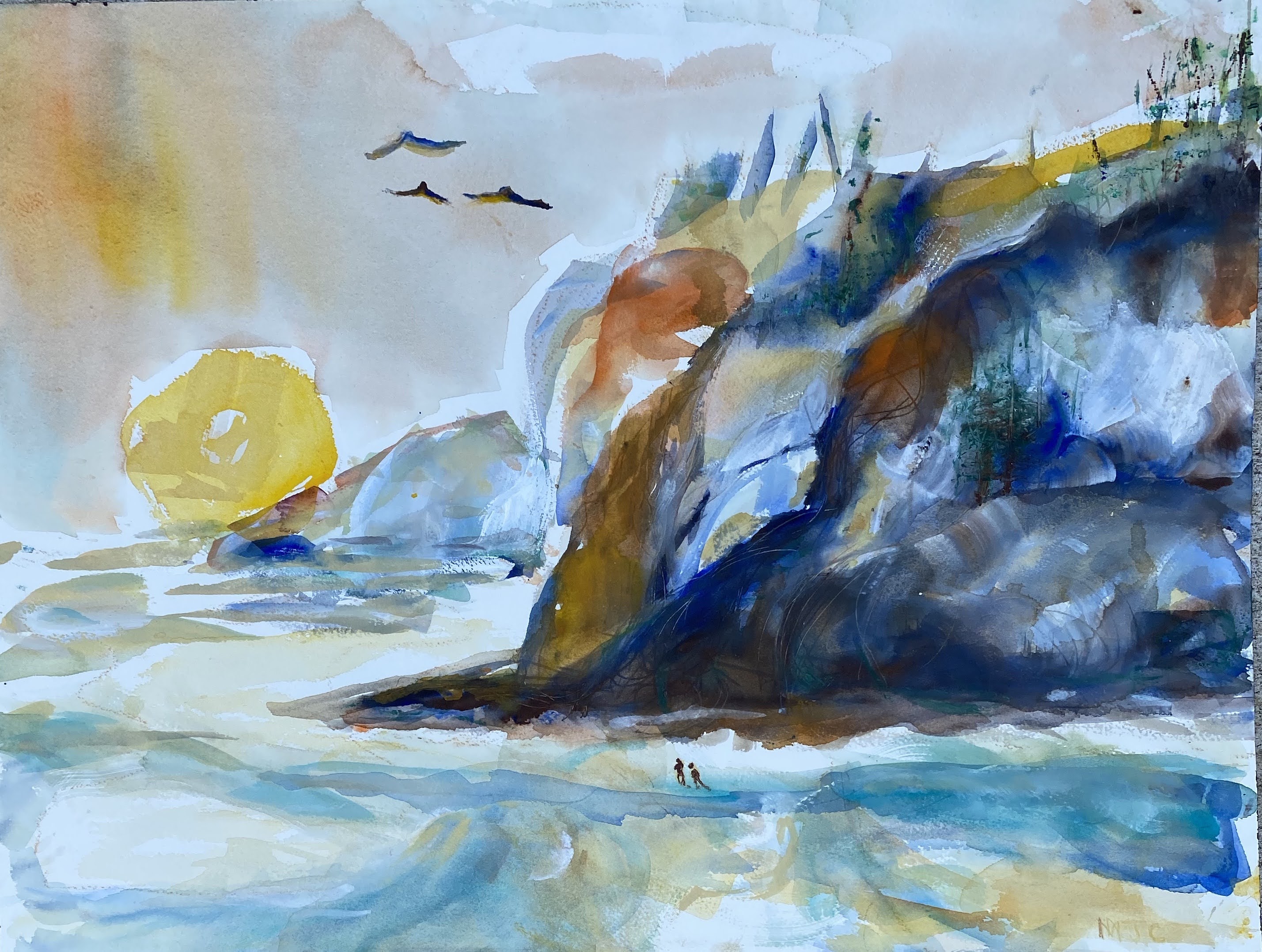
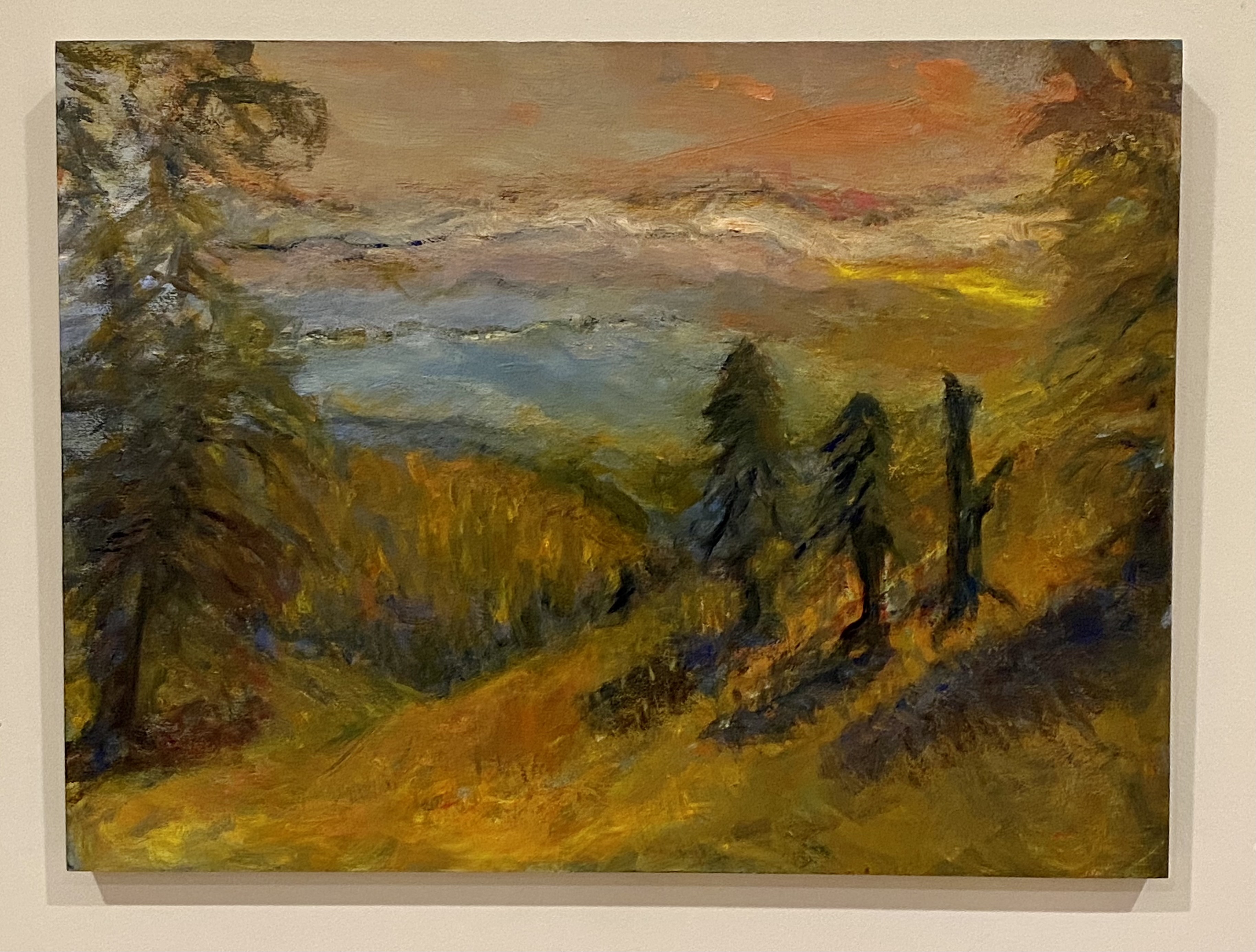
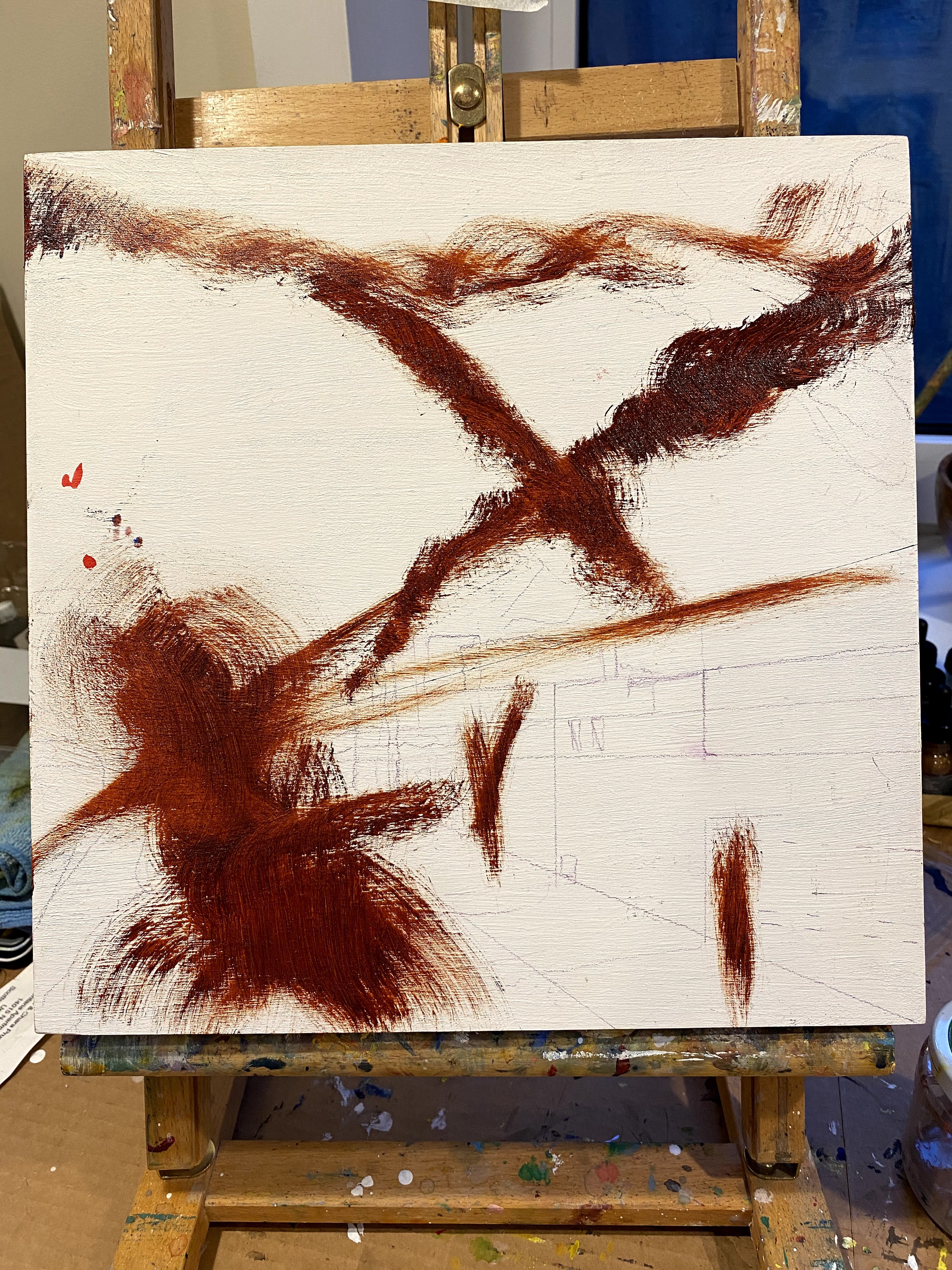
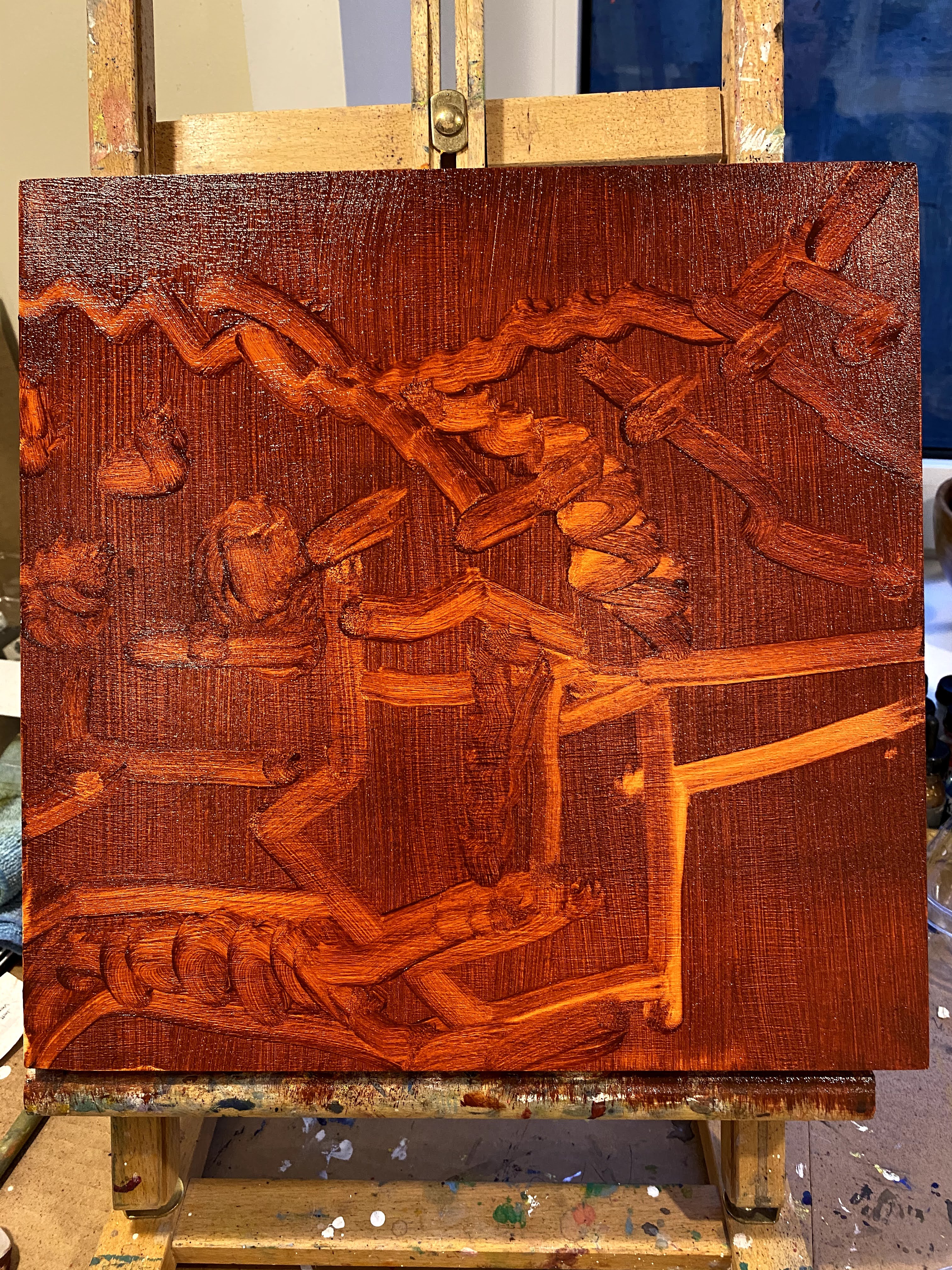
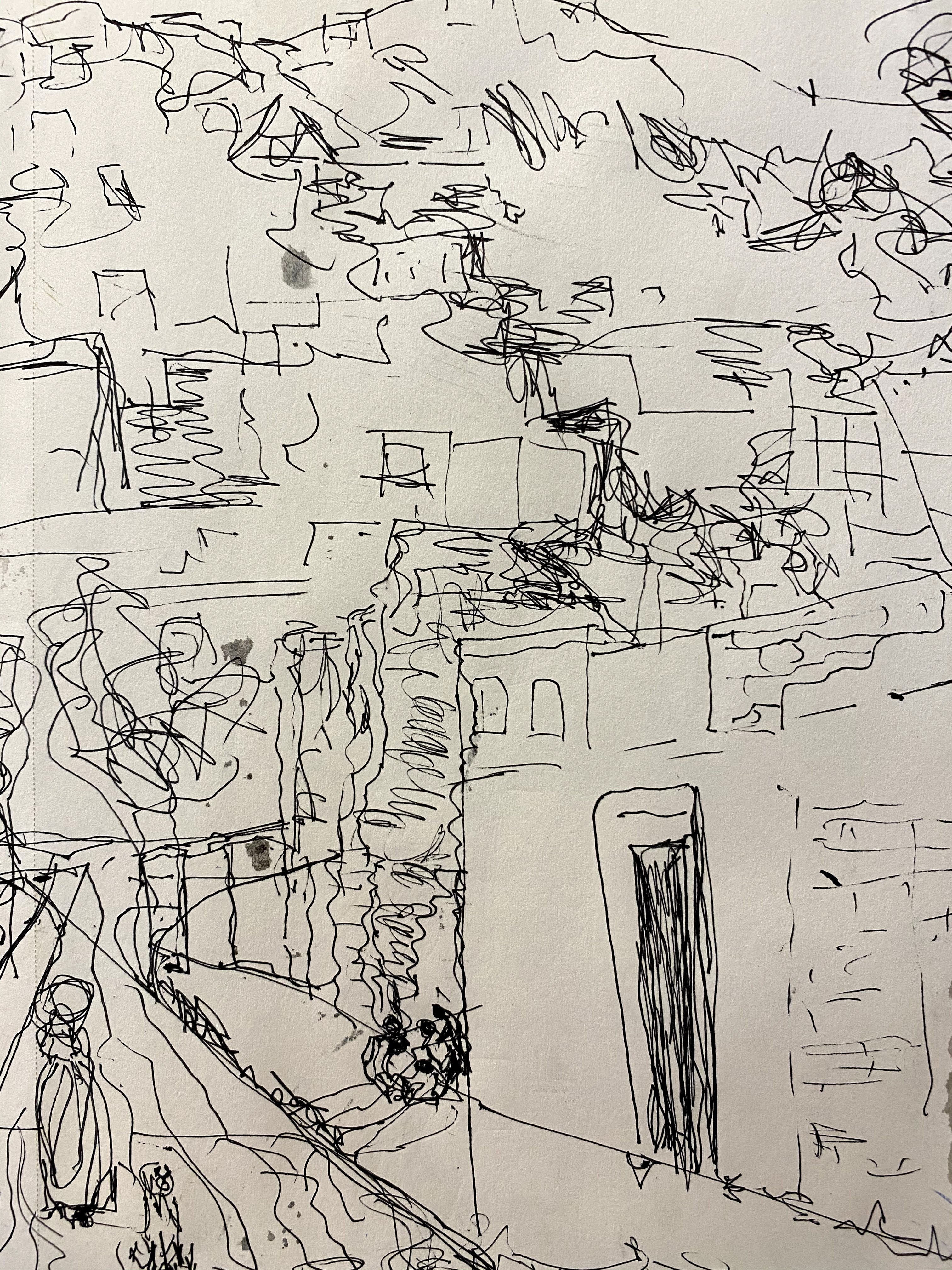
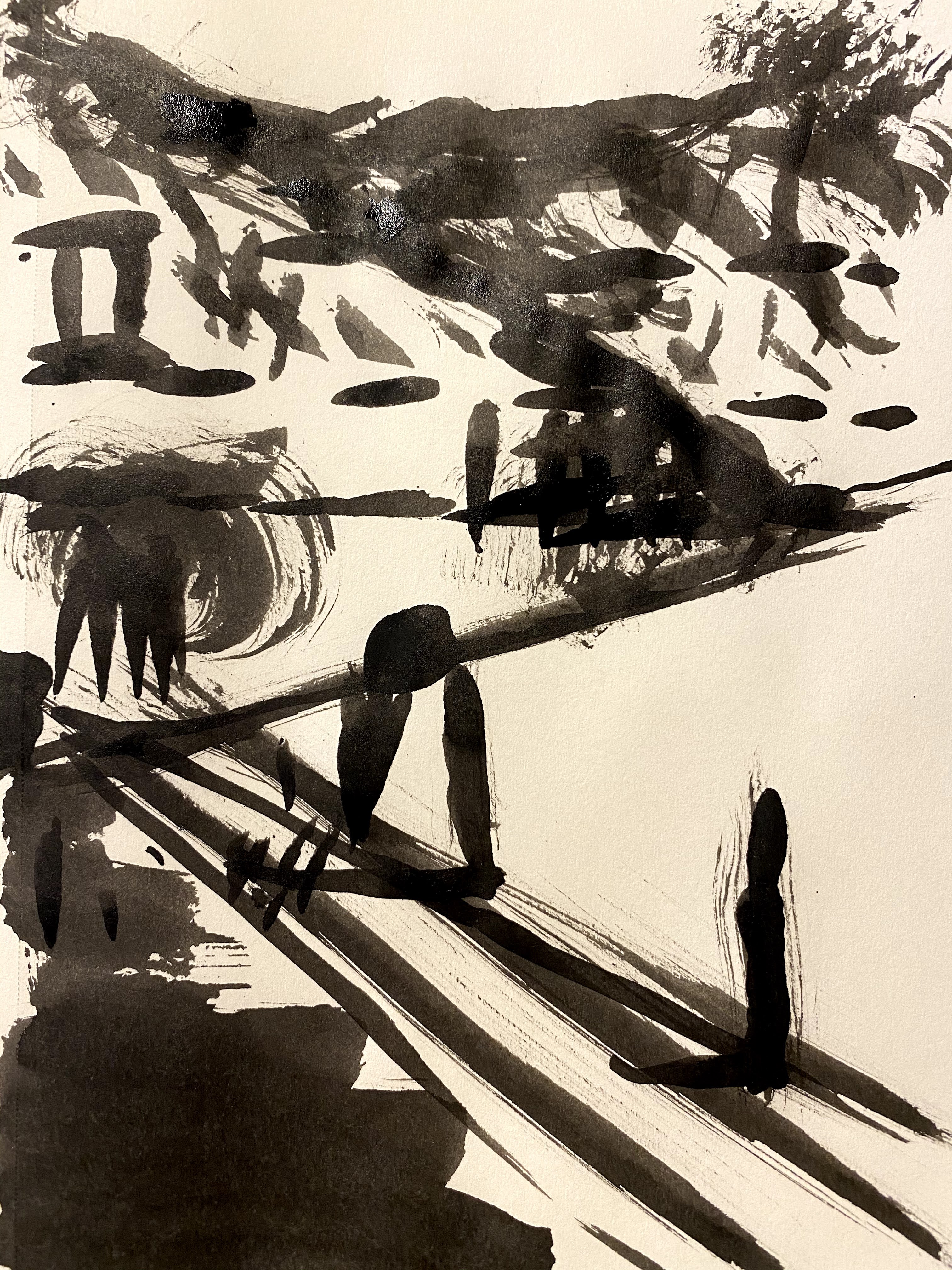
 Using the method we had earlier learned of placing transparent paint onto the canvas and then using rags or paper towels to remove some of the paint to leave big shapes and values, I ended up this this sketch for my intended oil painting.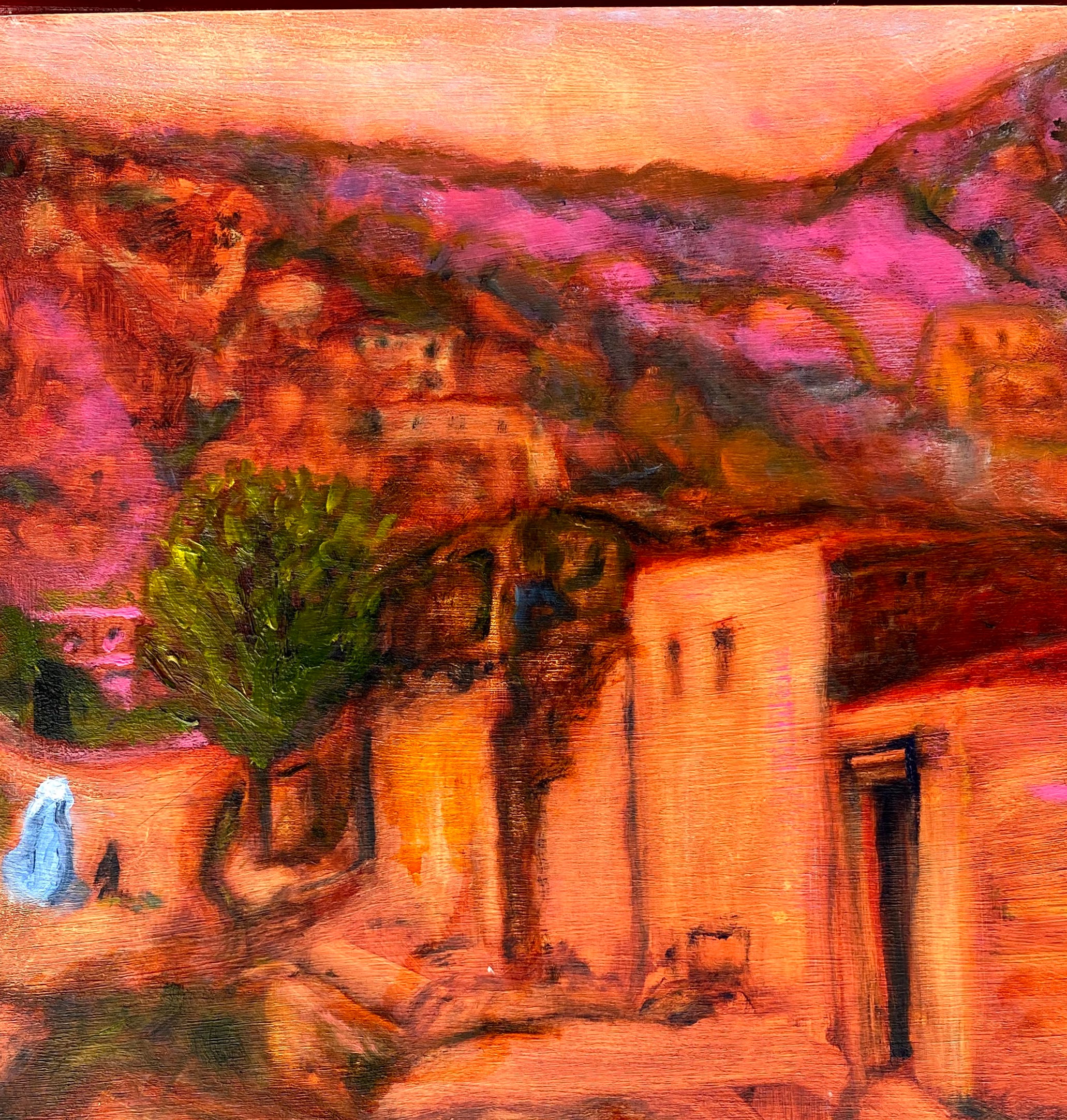
 marysgardens